
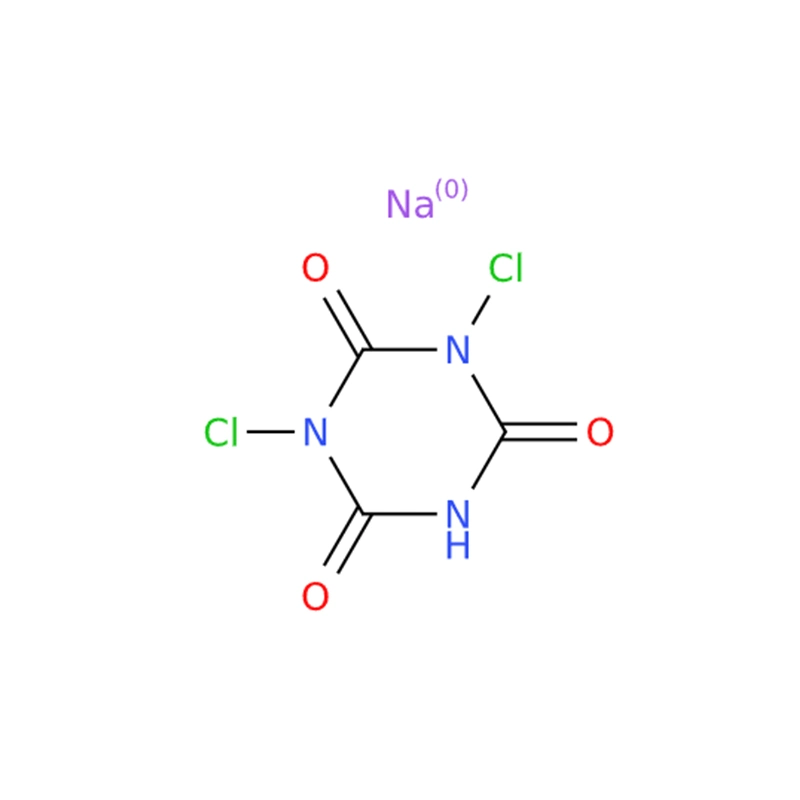
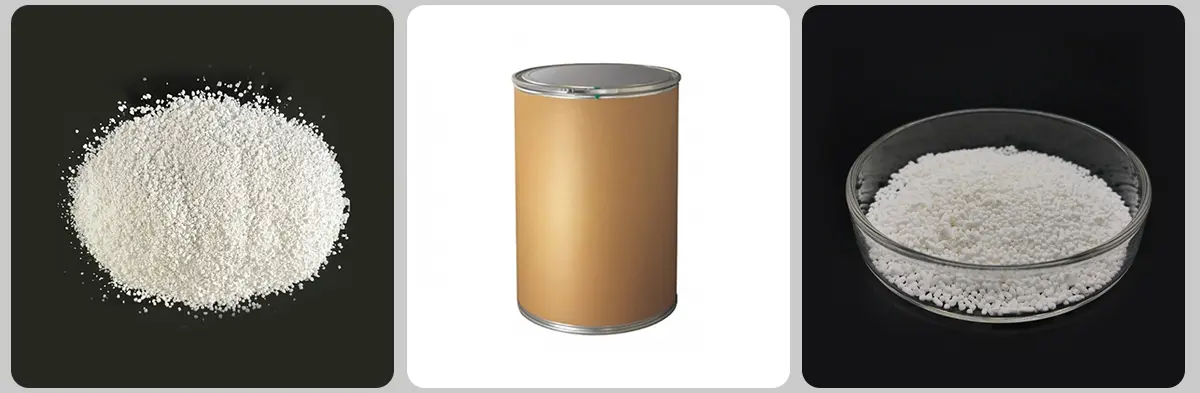
Sodium dichloroisocyanurate appears as a white crystalline solid carrying a pungent chlorine smell, containing 60%–64.5% available chlorine. It boasts satisfactory storage stability; under hot and humid storage environments, the loss rate of its available chlorine is merely around 1%.
This compound dissolves easily in water, reaching roughly 25% solubility at 25°C. Its aqueous solution is weakly acidic: a 1% solution registers a pH value between 5.8 and 6.0, and its pH will not fluctuate significantly even if the solution concentration rises. Upon dissolution in water, hypochlorous acid is formed. Its hydrolysis constant stands at 1 × 10⁻⁴, a value superior to that of chloramine-T.
While its water solution is comparatively unstable and ultraviolet light will speed up the depletion of available chlorine, sodium dichloroisocyanurate possesses powerful sanitizing capacity. It can swiftly inactivate an array of vegetative bacteria, fungi and viruses even at dilute dosages, and delivers outstanding germicidal activity against hepatitis viruses in particular.
Distinguished by high available chlorine levels, potent bactericidal activity, straightforward manufacturing procedures and economical cost, sodium dichloroisocyanurate features low toxicity and outperforms bleaching powder and chloramine-T in disinfection efficiency.
Dry sodium dichloroisocyanurate powder can be blended with metallic reducing agents, acidic synergists and potassium permanganate to formulate chlorine-based fumigants or acid chlorine fumigants. Once ignited, these formulations release gas with formidable germicidal potency.
Sodium dichloroisocyanurate is widely utilized for sanitizing drinking water and tableware. It is also applicable to surface disinfection of fruits and eggs, helping extend their shelf life.
The product is widely deployed for large-scale disinfection work in flood control and disaster relief, as well as preventive sterilization in areas suffering from infectious disease epidemics.
In sericulture, sodium dichloroisocyanurate can be applied in fumigation, liquid solution or powder form to disinfect silkworm houses, silkworm-raising equipment and silkworm bodies.
It works to prevent and treat fish diseases induced by bacteria, fungi and algae, and exerts marked effects on viral diseases of aquatic products.
Besides, a 2%–3% chloramine aqueous solution mixed with other auxiliaries can be adopted for soaking treatment of wool and wool-blend fibers and fabrics. This treatment prevents wool products from pilling and shrinking, enabling the finished textiles to meet the superwash standards set by the International Wool Secretariat.
Sodium dichloroisocyanurate Chemical Properties
| Melting point | 225°C |
| density | 1 g/cm3 |
| vapor pressure | 0.006Pa at 20℃ |
| storage temp | 0-6°C |
| solubility | DMSO (Slightly, Heated), Methanol (Slightly, Heated, Sonicated), Water |
| form | powder to lump |
| color | White to Almost white |
| Water Solubility | 30g/100ml (25 ºC) |
| Sensitive | Moisture Sensitive |
| BRN | 4056155 |
| Stability | Stable. Oxidizing agent - contact with combustible material may lead to fire. Incompatible with strong bases, strong oxidizing agents. Reacts readily with many nitrogen-containing compounds to form explosive nitrogen triiodide. Moisture-sensitive. |
| InChI | InChI=1S/C3HCl2N3O3.Na/c4-7-1(9)6-2(10)8(5)3(7)11;/h(H,6,9,10);/q;+1/p-1 |
| InChIKey | MSFGZHUJTJBYFA-UHFFFAOYSA-M |
| SMILES | C1(=O)N(Cl)C(=NC(=O)N1Cl)[O-].[Na+] |
| EPA Substance Registry System | Sodium dichloro-s-triazinetrione (2893-78-9) |
| Hazard Codes | O,Xn,N,E |
| Risk Statements | 8-22-31-36/37-50/53-2 |
| Safety Statements | 8-26-41-60-61-45 |
| RIDADR | UN 2465 5.1/PG 2 |
| WGK Germany | 2 |
| RTECS | XZ1900000 |
| TSCA | Yes |
| HazardClass | 5.1 |
| PackingGroup | II |
| HS Code | 29336929 |
| Hazardous Substances Data | 2893-78-9(Hazardous Substances Data) |

Product Application of Sodium Dichloroisocyanurate CAS#2893-78-9
Sodium dichloroisocyanurate serves as a common sanitizer for potable water and tableware. It is also suitable for surface decontamination of fruits and eggs to lengthen their shelf life.
This chemical is extensively adopted for bulk sanitization tasks amid flood management and disaster aid, alongside precautionary disinfection within regions stricken by communicable disease outbreaks.
Within sericulture operations, sodium dichloroisocyanurate may be administered via fumigation, liquid preparations or powdered form to sanitize silkworm rearing chambers, breeding gear and silkworms.
It functions for the prophylaxis and remedy of fish disorders triggered by bacteria, fungi and algae, and yields remarkable outcomes when tackling viral ailments in aquatic stock.
Moreover, a 2%–3% chloramine aqueous formulation blended with supplementary auxiliaries can be utilised for the immersion processing of wool and wool-mixed fibres and textiles. This procedure mitigates pilling and shrinkage of wool goods, allowing the finished fabrics to comply with superwash criteria defined by the International Wool Bureau.