

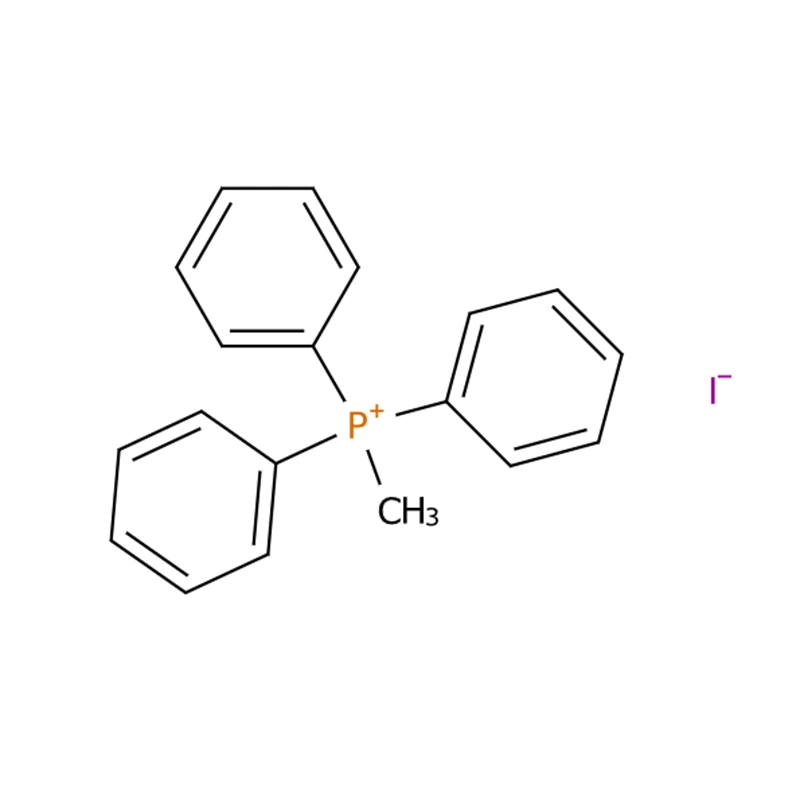
Methyltriphenylphosphonium iodide CAS#2065-66-9
Methyltriphenylphosphonium iodide is an organophosphorus compound with the molecular formula C₁₉H₁₈IP, a molecular weight of 404.22, and CAS No. 2065-66-9. It is typically presented as a white powder and is also known as methyltriphenylphosphonium iodide or triphenylmethylphosphonium iodide. The compound has a melting point of 183–188 °C (with decomposition) and a flash point of 235 °C.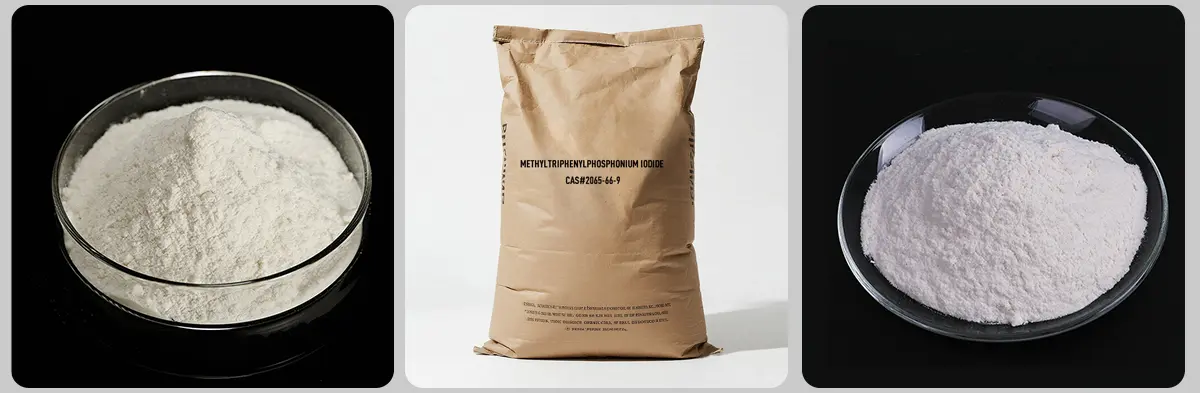
Methyltriphenylphosphonium iodide Chemical Properties
| Melting point | 183-185 °C(lit.) |
| storage temp. | Keep in dark place,Inert atmosphere,Room temperature |
| solubility | Chloroform (Slightly), Methanol (Slightly) |
| form | Powder |
| color | White to light yellow |
| Water Solubility | SOLUBLE |
| Sensitive | Light Sensitive & Hygroscopic |
| InChI | InChI=1S/C19H18P.HI/c1-20(17-11-5-2-6-12-17,18-13-7-3-8-14-18)19-15-9-4-10-16-19;/h2-16H,1H3;1H/q+1;/p-1 |
| InChIKey | JNMIXMFEVJHFNY-UHFFFAOYSA-M |
| SMILES | [P+](C)(C1=CC=CC=C1)(C1=CC=CC=C1)C1=CC=CC=C1.[I-] |
| CAS DataBase Reference | 2065-66-9(CAS DataBase Reference) |
Safety Information
| Hazard Codes | Xi,T |
| Risk Statements | 36/37/38-25 |
| Safety Statements | 26-36-45-37/39-28A |
| RIDADR | UN3464 |
| WGK Germany | 3 |
| HazardClass | 6.1 |
| PackingGroup | III |
| HS Code | 29319090 |

Product Application of Methyltriphenylphosphonium iodide CAS#2065-66-9
It is primarily used in organic synthesis, including the preparation of pyrene-containing polyolefin materials for dye-sensitized solar cells, as well as in catalytic processes for synthesizing carbasugars and alkaloids. In addition, it participates in reactions such as olefin oxidation to carbene species and dehydrogenation halogenation-Heck reactions. For storage, it should be protected from light and kept under an argon atmosphere.