
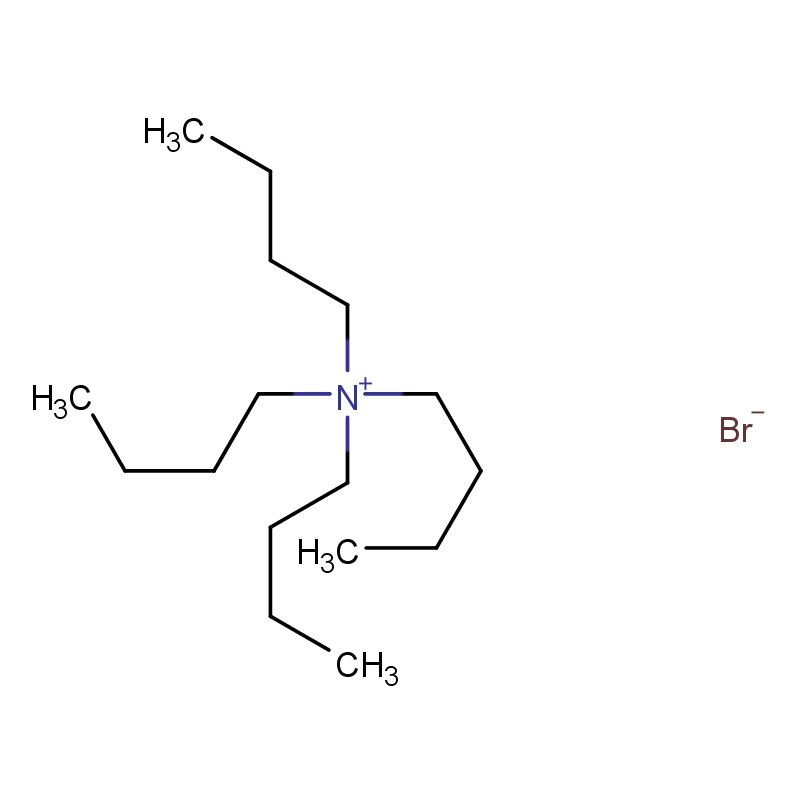
Tetrabutylammonium bromide is an eco-friendly, non-volatile, non-flammable, and non-corrosive ammonium salt that is low-cost, readily available, and exhibits excellent thermal and chemical stability. It is soluble in both aqueous and organic solvents, facilitating the transfer of water-soluble anionic reactants into the organic phase. Additionally, molten TBAB can serve as an efficient ionic liquid for performing organic transformations under solvent-free conditions.
| Melting point | 102-106 °C(lit.) |
| Boiling point | 102 °C |
| Density | 1.039 g/mL at 25 °C |
| Bulk density | 700kg/m3 |
| Vapor pressure | 0Pa at 25℃ |
| Refractive index | n20/D 1.422 |
| Fp | 100℃ |
| Storage temp | Store below +30°C. |
| Solubility | H2O: 0.1 g/mL, clear, colorless |
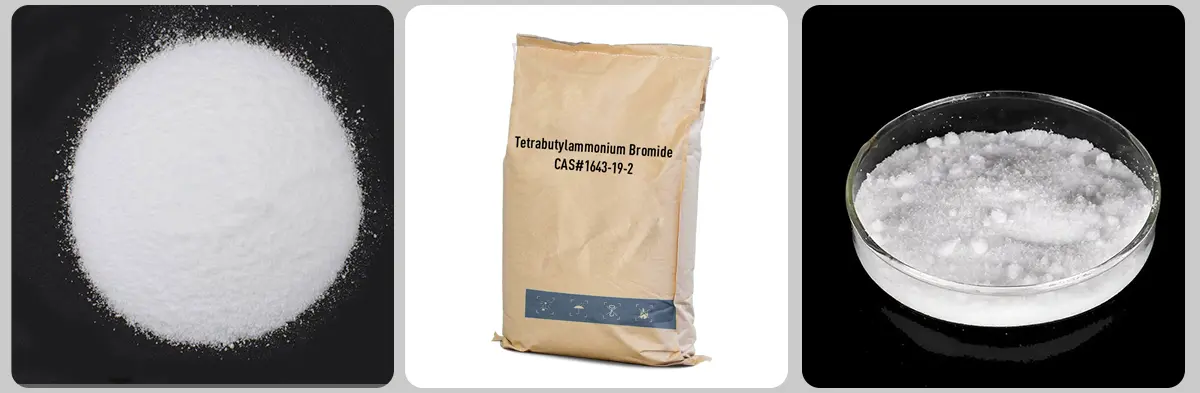
| Form | Crystalline Powder |
| Pka | 0[at 20 ℃] |
| Specific Gravity | 1.007 |
| Color | White to slightly cream |
| Odor | Amine like |
| PH | 3.5 to 7.0 (50 g/L, 25 ℃) |
| Water Solubility | 600 g/L (20 ºC) |
| Sensitive | Hygroscopic |
| λmax | λ: 240 nm Amax: 0.04 λ: 250 nm Amax: 0.03 λ: 260 nm Amax: 0.02 λ: 500 nm Amax: 0.02 |
| BRN | 3570983 |
| Stability | Stable. Incompatible with strong oxidizing agents. Protect from moisture. |
| InChIKey | JRMUNVKIHCOMHV-UHFFFAOYSA-M |
| LogP | 0.839 at 25℃ |
| CAS DataBase Reference | 1643-19-2(CAS DataBase Reference) |
| NIST Chemistry Reference | Tetra-N-butylammonium bromide(1643-19-2) |
| EPA Substance Registry System | Tetrabutylammonium bromide (1643-19-2) |
Tetrabutylammonium bromide (TBAB) is a quaternary ammonium compound and the most widely used phase transfer catalyst. Its interfacial properties have been examined in hydroxide-initiated reactions, providing insights into the mechanisms of phase transfer processes. TBAB has been shown to reduce retention time and eliminate peak tailing by functioning as an ion-pair reagent in the chromatographic analysis of quaternary ammonium compounds. In its molten state, TBAB acts as an ionic liquid, offering a green and sustainable alternative to organic solvents in organic synthesis. Its molar heat capacity, entropy, and free energy function have also been determined.