
Ethyl Formate CAS 109-94-4
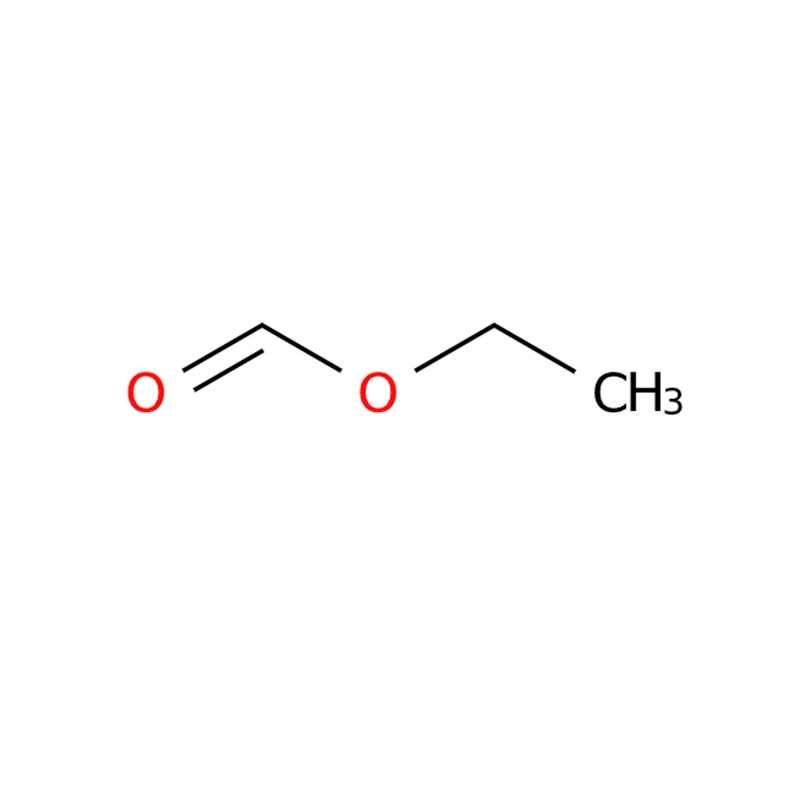
Ethyl formate, sometimes referred to as ethyl formic ester, is a low-viscosity, colorless liquid. It is authorized as a food flavor additive in line with GB2760-96 standards. It is extensively applied to craft flavor profiles for rum, apricot, peach, pineapple, compound fruit and sherry. This compound arises naturally in Boronia dentigeroides, Florida orange juice, honey, brandy, strawberries, raspberries, onions, apples, pears and rum. For commercial manufacturing, ethyl formate is synthesized through the esterification of ethanol and formic acid catalyzed by sulfuric acid. Subsequent dehydration with phosphorus pentoxide or anhydrous calcium chloride and distillation yield the finished product.
Melting point | -80 °C (lit.) |
Boiling point | 52-54 °C (lit.) |
density | 0.921 g/mL at 20 °C (lit.) |
vapor density | 2.5 (vs air) |
vapor pressure | 15.16 psi ( 55 °C) |
refractive index | n20/D 1.359(lit.) |
FEMA | 2434 | ETHYL FORMATE |
Fp | 7 °F |
storage temp. | 2-8°C |
solubility | Miscible with alcohol, benzene, and ether (Hawley, 1981) |
form | Liquid |
color | Clear |
Odor | Characteristic; pleasant aromatic. |
Odor Threshold | 2.7ppm |
Odor Type | ethereal |
biological source | synthetic |
explosive limit | 0.16 |
Water Solubility | 11 g/100 mL (18 ºC) |
Thermal Conductivity | 0.16 W/(m·K) at 25 ℃ |
Sensitive | Moisture Sensitive |
JECFA Number | 26 |
Merck | 143807 |
BRN | 906769 |
Henry's Law Constant | 0.097(x 10-3 atmm3/mol) at 5.00 °C, 0.13 at 10.00 °C, 0.17 at 15.00 °C, 0.23 at 20.00 °C, 0.29 at 25.00 °C (column stripping-UV, Kutsuna et al., 2005) |
Dielectric constant | 8.4(6℃) |
Exposure limits | TLV-TWA 100 ppm (~300 mg/m3) (ACGIH, MSHA, and OSHA); IDLH 8000 ppm (NIOSH). |
Stability: | Stable. Extremely flammable. May form explosive mixtures with air. Note low flash point and wide explosive limits. Incompatible with strong oxidizing agents, strong bases, strong acids, nitrates. |
Major Application | agriculture |
cleaning products | |
cosmetics | |
environmental | |
food and beverages | |
personal care | |
Cosmetics Ingredients Functions | PERFUMING |
InChI | 1S/C3H6O2/c1-2-5-3-4/h3H,2H2,1H3 |
InChIKey | WBJINCZRORDGAQ-UHFFFAOYSA-N |
SMILES | CCOC=O |
LogP | 1.504 at 25℃ |
CAS DataBase Reference | 109-94-4(CAS DataBase Reference) |
NIST Chemistry Reference | Formic acid, ethyl ester(109-94-4) |
EPA Substance Registry System | Ethyl formate (109-94-4) |
Safety Information
Hazard Codes | F,Xn |
Risk Statements | 11-20/22-36/37 |
Safety Statements | 9-16-24-26-33 |
OEB | A |
OEL | TWA: 100 ppm (300 mg/m3) |
RIDADR | UN 1190 |
WGK Germany | 1 |
RTECS | LQ8400000 |
Autoignition Temperature | 851 °F |
TSCA | TSCA listed |
HazardClass | 3 |
PackingGroup | II |
HS Code | 29151300 |
Storage Class | 3 - Flammable liquids |
Hazard Classifications | Acute Tox. 4 Inhalation |
Acute Tox. 4 Oral | |
Eye Irrit. 2 | |
Flam. Liq. 2 | |
STOT SE 3 | |
Hazardous Substances Data | 109-94-4(Hazardous Substances Data) |
Toxicity | LD50 orally in rats: 4.29 g/kg (Smyth) |
IDLA | 1,500 ppm |

Product Application of CAS#109-94-4
Ethyl formate is frequently employed as a solvent for nitrocellulose and cellulose acetate. Within the pharmaceutical sector, it acts as a key building block for the synthesis of uracil, cytosine and thymine.