
Methyl Acetate CAS#79-20-9
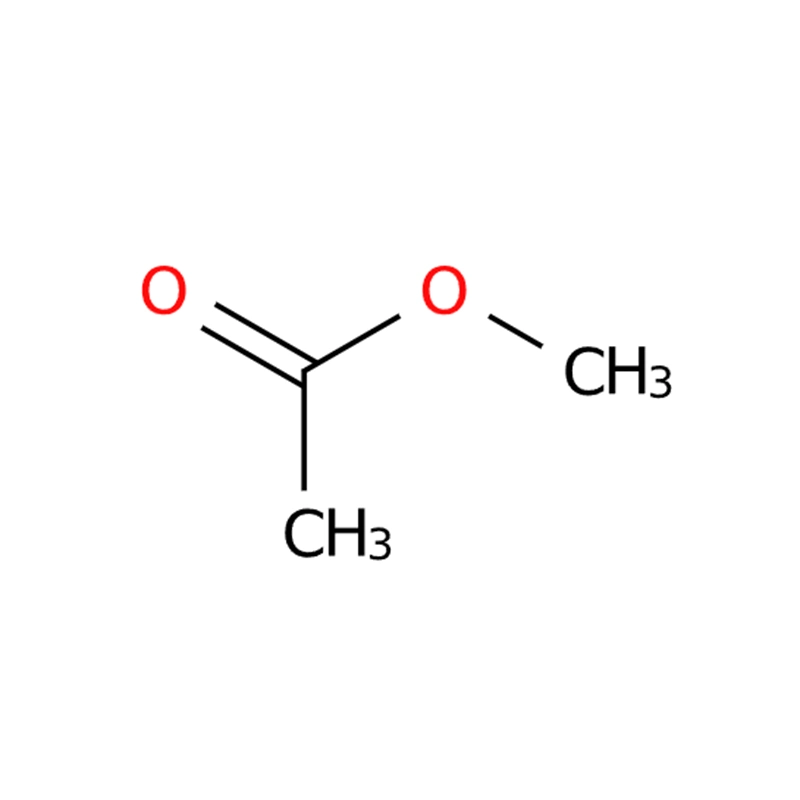
Methyl acetate, alternatively abbreviated as MeOAc and also named methyl ethanoate or methyl ester of acetic acid, is a carboxylate ester with the molecular formula CH₃COOCH₃. This flammable, colourless liquid carries a mild agreeable scent reminiscent of some adhesives and nail polish removers.
Thanks to its low polarity and lipophilic nature, methyl acetate is widely deployed as a solvent. In contrast to ethyl acetate, its structural analogue, it boasts greater water solubility — roughly 25% at ambient temperature, and this value rises when the temperature goes up.
It will undergo decomposition when exposed to strong aqueous acids or alkalis, which calls for proper precautions during handling. Furthermore, methyl acetate holds VOC-exempt classification, which fits it well for projects that need to satisfy environmental regulatory requirements.

Methyl acetate Chemical Properties
Melting point | -98 °C (lit.) |
Boiling point | 57-58 °C (lit.) |
density | 0.934 g/mL at 25 °C |
vapor density | 2.55 (vs air) |
vapor pressure | 165 mm Hg ( 20 °C) |
refractive index | n20/D 1.361(lit.) |
FEMA | 2676 | METHYL ACETATE |
Fp | 3.2 °F |
storage temp. | no restrictions. |
solubility | 250g/l |
form | Solution |
color | Clear colorless to slightly pale yellow |
Relative polarity | 0.253 |
Odor | Slightly acrid, sweet; fragrant. |
explosive limit | 3.1-16%(V) |
Odor Threshold | 1.7ppm |
Odor Type | ethereal |
Water Solubility | 250 g/L (20 ºC) |
λmax | λ: 255 nm Amax: 1.0 |
λ: 275 nm Amax: 0.1 | |
λ: 300 nm Amax: 0.01 | |
JECFA Number | 125 |
Merck | 146008 |
BRN | 1736662 |
Henry's Law Constant | 0.90 at 20.00 °C, 1.56 at 30.00 °C (headspace-GC, Hovorka et al., 2002) |
Exposure limits | TLV-TWA 200 ppm (~610 mg/m3) (ACGIH, MSHA, and OSHA); TLV-STEL 250 ppm (~760 mg/m3) (ACGIH); IDLH 10,000 ppm (NIOSH). |
Dielectric constant | 7.3(20℃) |
Stability: | Stable. Extremely flammable - readily forms explosive mixtures with air. Note low flash point and wide explosion limits. Incompatible with strong oxidizing agents, strong bases, strong acids, nitrates. May be moisture sensitive. |
LogP | 0.18 at 20℃ |
CAS DataBase Reference | 79-20-9(CAS DataBase Reference) |
NIST Chemistry Reference | Acetic acid, methyl ester(79-20-9) |
EPA Substance Registry System | Methyl acetate (79-20-9) |
Safety Information
Hazard Codes | F,Xi |
Risk Statements | 11-36-66-67 |
Safety Statements | 16-26-29-33 |
RIDADR | UN 1231 3/PG 2 |
OEB | A |
OEL | TWA: 200 ppm (610 mg/m3), STEL: 250 ppm (760 mg/m3) |
WGK Germany | 1 |
RTECS | AI9100000 |
Autoignition Temperature | 936 °F |
TSCA | Yes |
HS Code | 2915 39 00 |
HazardClass | 3 |
PackingGroup | II |
Hazardous Substances Data | 79-20-9(Hazardous Substances Data) |
Toxicity | LD50 orally in Rabbit: > 5000 mg/kg LD50 dermal Rat > 2000 mg/kg |
IDLA | 3,100 ppm [10% LEL] |

Product Usage Of Methyl Acetate CAS#79-20-9
Methyl acetate can react with rapeseed oil under supercritical conditions in a catalyst-free transesterification reaction to generate fatty acid methyl esters and triacetin.
It also finds application in the areas listed below:
Serving as an acyl acceptor during biodiesel manufacturing.
Being utilized for ethanol synthesis.
Producing n-butyl acetate by transesterification with n-butanol under acid catalysis.
Acting as a chemical intermediate and starting material for synthesizing a broad range of organic substances.