
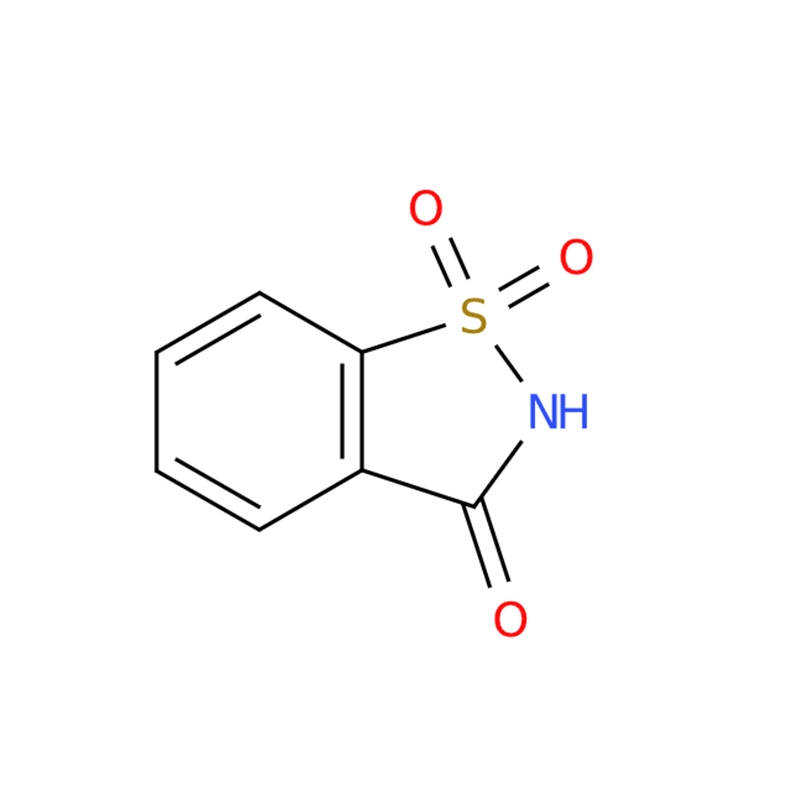
Product Description of Saccharin (CAS No. 81-07-2)
Pure saccharin is a non-toxic, zero-calorie, and non-nutritive sweetener that is not absorbed by the human body. It is widely used as a sugar substitute in food applications due to its sweet taste. As a food additive, it provides sweetness without contributing nutritional value, meeting consumer demand for sugar-free products. The saccharin commonly available on the market is typically in the form of its sodium salt, known as saccharin sodium.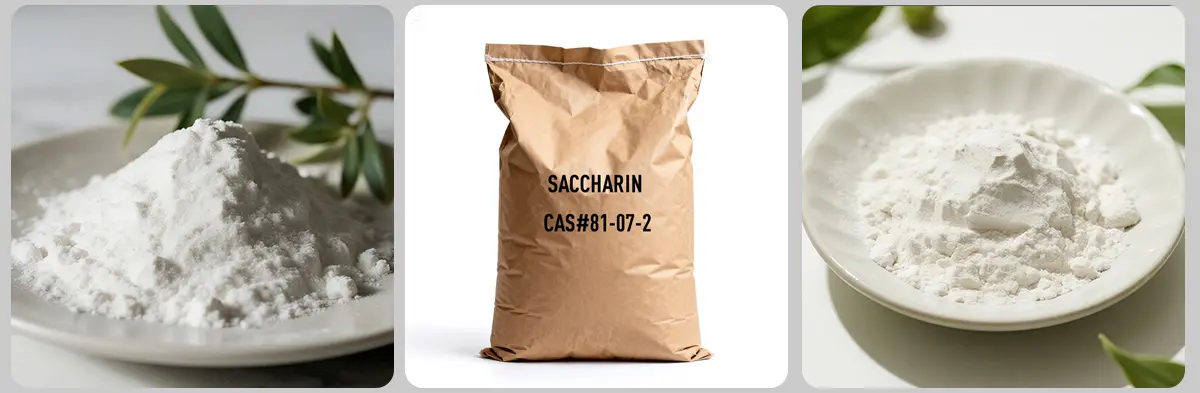
Saccharin Chemical Properties
| Melting point | 226-229 °C (lit.) |
| Boiling point | subl |
| Density | 0.828 |
| Vapor pressure | 0Pa at 25℃ |
| Refractive index | 1.5500 (estimate) |
| Storage temp | Store below +30°C. |
| Solubility | acetone: soluble1g in 12mL(lit.) |
| Pka | 11.68(at 18℃) |
| Form | Crystals or Crystalline Powder |
| Color | White |
| Odor | odorless |
| Water Solubility | 3.3 g/L (20 ºC) |
| Merck | 148311 |
| BRN | 6888 |
| Stability | Stable. Incompatible with strong oxidizing agents. |
| InChIKey | CVHZOJJKTDOEJC-UHFFFAOYSA-N |
| LogP | -0.024 at 25℃ |
| CAS DataBase Reference | 81-07-2(CAS DataBase Reference) |
| IARC | 3 (Vol. Sup 7, 73) 1999 |
| NIST Chemistry Reference | Saccharin(81-07-2) |
| EPA Substance Registry System | Saccharin (81-07-2) |
Safety Information
| Risk Statements | 40-62-63-68 |
| Safety Statements | 24/25 |
| RIDADR | UN 3077 9/PG 3 |
| WGK Germany | 2 |
| RTECS | DE4200000 |
| TSCA | Yes |
| HazardClass | IRRITANT |
| HS Code | 29251100 |
| Hazardous Substances Data | 81-07-2(Hazardous Substances Data) |
| Toxicity | LD50 oral in mouse: 17gm/kg |
Product Applications of Saccharin (CAS No. 81-07-2)
Saccharin, also known as o-benzoylsulfonyl imide, is used as an intermediate in the production of agrochemicals such as fungicides and herbicides, including allylthiazole, metsulfuron-methyl, bensulfuron-methyl, ethametsulfuron-methyl, and chlorimuron-methyl.
It is also a non-nutritive sweetener, typically applied in the form of its sodium or ammonium salt. Due to its slow dissolution in the mouth, it is particularly suitable for products like chewing gum (with a maximum usage level of 0.05 g/kg, Japan, 1998).
In addition, saccharin is used in the manufacture of pesticide intermediates and saccharin sodium, as well as in formulations requiring sweet taste enhancement for mammals. It can also function as an inhibitor of phosphotransferase and phosphohydrolase, and is used in analytical applications such as thallium testing.