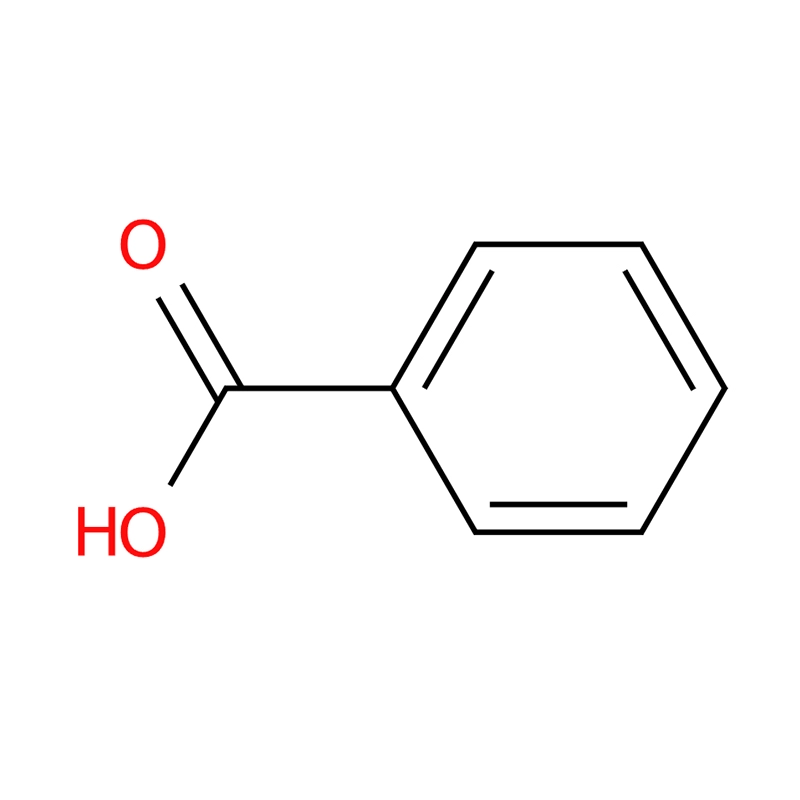
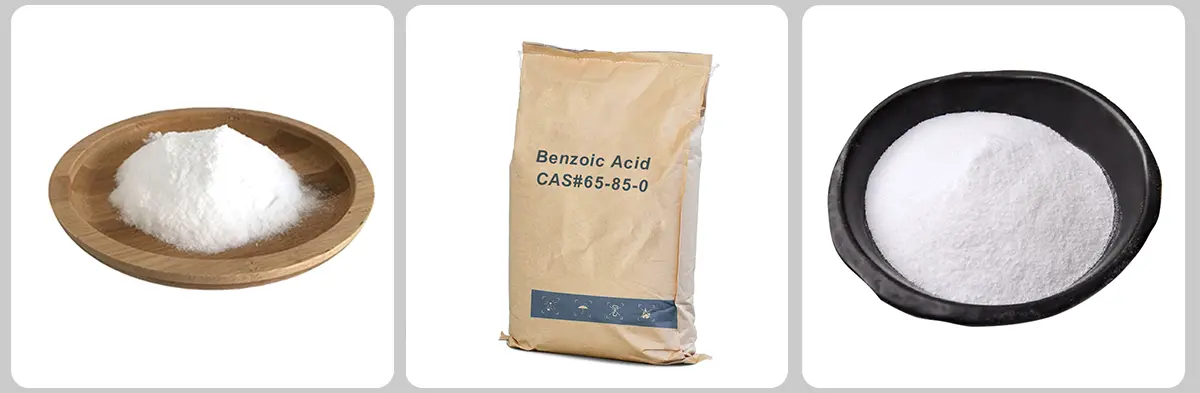
Benzoic Acid, the most basic member of the aromatic carboxylic acid group, is a weak acid that serves as a precursor in the production of numerous key organic compounds. Over 90% of commercially produced benzoic acid is directly transformed into phenol and caprolactam. Additionally, its use in creating glycol benzoates, which function as plasticizers in adhesive formulations, is on the rise.
Parameters
Melting point | 121-125 °C(lit.) |
Boiling point | 249 °C(lit.) |
bulk density | 500kg/m3 |
density | 1.08 |
vapor density | 4.21 (vs air) |
vapor pressure | 10 mm Hg ( 132 °C) |
refractive index | 1.504 |
FEMA | 2131 | BENZOIC ACID |
Fp | 250 °F |
storage temp | 2-8°C |
solubility | soluble, clear, colorless (95% ethanol, 1gm/3mL) |
pka | 4.19(at 25℃) |
form | Solid |
color | White to yellow-beige to orange |
PH | 3.66(1 mM solution);3.12(10 mM solution);2.6(100 mM solution); |
Odor | at 100.00 %. faint balsam urine |
Odor Type | balsamic |
biological source | synthetic |
Water Solubility | Slightly soluble. 0.34 g/100 mL |
Merck | 14,1091 |
JECFA Number | 850 |
BRN | 636131 |
Henry's Law Constant | (x 10-8 atm?m3/mol): 7.02 (calculated, U.S. EPA, 1980a) |
Stability | Stable. Combustible. Incompatible with strong bases, strong oxidizing agents, alkalies. |
InChIKey | WPYMKLBDIGXBTP-UHFFFAOYSA-N |
LogP | 1.870 |
CAS DataBase Reference | 65-85-0(CAS DataBase Reference) |
NIST Chemistry Reference | Benzoic acid(65-85-0) |
EPA Substance Registry System | Benzoic acid (65-85-0) |
Safety Information
Hazard Codes | Xn,T,Xi |
Risk Statements | 22-36-42/43-36/37/38-40-63-43-23/24/25-45-41-37/38-20/21/22-48/23-38-67-37 |
Safety Statements | 26-45-37/39-24-22-36/37-24/25-23-53-36-63-39 |
RIDADR | UN 3077 9/PG 3 |
WGK Germany | 1 |
RTECS | DG0875000 |
F | 21 |
Autoignition Temperature | 570 °C |
Hazard Note | Harmful |
TSCA | Yes |
HS Code | 2916 31 00 |
Hazardous Substances Data | 65-85-0(Hazardous Substances Data) |
Toxicity | LD50 orally in Rabbit: 1700 mg/kg LD50 dermal Rabbit > 5000 mg/kg |
Benzoic acid is a crucial food preservative. Under acidic conditions, it effectively inhibits the growth of molds, yeast, and bacteria, although its action against acid-producing bacteria is relatively weaker. The most effective antimicrobial pH range is between 2.5 and 4, with an optimal pH typically between 4.5 and 5.