

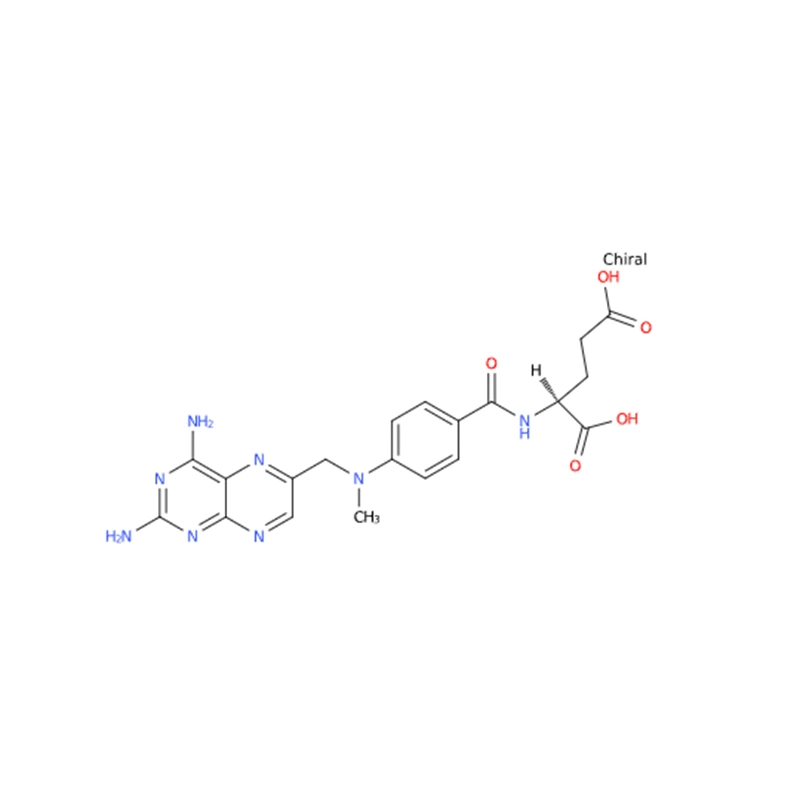
Product Description of Methotrexate CAS#59‑05‑2
Methotrexate is a potent antitumor agent indicated for the management of acute lymphoblastic leukemia, lymphoma, malignant hydatidiform mole, choriocarcinoma, squamous cell carcinoma, lung carcinoma, cervical carcinoma and breast carcinoma, as well as osteosarcoma.
Following oral administration, around 90% of the parent compound is excreted through urine within 12 hours, and 7‑hydroxymethotrexate constitutes its primary metabolite.
The intravenous LD50 value of methotrexate in rat models is 14 mg/kg.
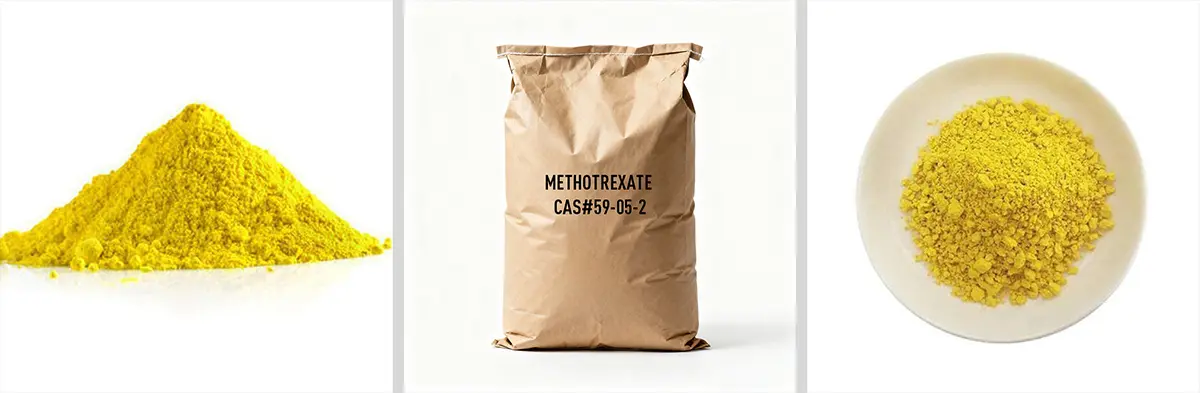
Product Parameters of Methotrexate CAS#59-05-2
Density | 1.536 |
Melting point | 195℃ |
Boiling point | 561.26°C (rough estimate) |
Refractive index | 1.6910 (estimate) |
Flash Point | 11℃ |
Precise Quality | 454.171 |
PSA | 210.54 |
logP | 1.8217 |
Solubility | H2O: insoluble |
Appearance | yellow crystalline powder |
Storage | Store at -20°C. Hygroscopic. Light Sensitive. |
Color/Form | Pale-yellow to Yellow-brown Solid |
Decomposition | When heated to decomposition it emits toxic fumes including /nitrogen oxides/. |
pKa | pKa 3.04/4.99(H2O,t =25,I=0.0025) (Uncertain) |
Water Solubility | Insoluble. |
Spectral Properties | Specific optical rotation: 20.4 + or - 0.6 deg at 21 deg C/589 D (concentration by 0.1 N sodium hydroxide) maximum absorption: 243nm, A1= 388;307 nm, A1 = 475 (in 0.1 n hydrogen chloride). 258 nm, A1= 544; 303 nm, A1= 546; 372 nm, A1= 177 (in 0.1 N sodium hydroxide)UV max (0.1N HCl) 244, 307 nm; UV max (0.1N NaOH) 257, 302, 370 nm |
Stability | Stable, but light sensitive and hygroscopic. Incompatible with strong acids, strong oxidizing agents. Store at -15C or below. |
StorageTemp | −20°C |

Product Application of Methotrexate CAS#59‑05‑2
Leukemia Treatment: Daily dosing represented the conventional therapeutic approach. Adult patients commonly receive an oral daily dose ranging from 2.5‑10 mg, with a cumulative total dosage of 50‑150 mg, whereas pediatric patients take 1.25‑5 mg each day. Contemporary clinical practice favors intermittent high‑dose regimens, administered either orally or intramuscularly twice weekly at 0.25‑0.75 mg/kg per dose; the standard per‑dose amount for adults falls within 20‑25 mg. For intrathecal delivery, adults are dosed at 10‑15 mg per administration, while children receive 6‑12 mg adjusted according to age. Therapy is generally delivered once daily across three consecutive days, and cycles are repeated every 4‑8 weeks for maintenance or prophylactic purposes.
Choriocarcinoma: Adult patients usually receive 10‑30 mg via oral or intramuscular routes once daily over five successive days. Treatment cycles may be repeated based on individual patient therapeutic responses.
Solid Tumors: Continuous intra‑arterial infusion is the preferred modality, paired with intermittent intramuscular leucovorin (CF) injections. The routine dosage consists of 25‑50 mg per day of methotrexate, alongside 6‑9 mg of CF given intramuscularly every 4‑6 hours.
Osteosarcoma: High‑dose methotrexate combined with CF rescue intervention is adopted. The general dosage is 3‑20 g/m², dissolved in 500‑1000 mL of 5% glucose solution and infused intravenously over a 4‑hour period. CF rescue is initiated 2‑6 hours post‑infusion at 6‑12 mg administered intramuscularly (or orally), repeated every six hours for a total duration of three days. To facilitate rapid drug clearance, electrolytes and fluids need to be supplemented on day one and at 1‑2‑day intervals afterwards to sustain daily urine output above 3000 mL and achieve urinary alkalinization. Daily monitoring of liver function, renal function, hematological parameters and plasma methotrexate concentrations is required.
Psoriasis: Owing to considerable adverse‑reaction risks, methotrexate is seldom utilized for this indication. If prescribed, each oral dose is 1.25 mg taken two to three times per day, with a full treatment cycle spanning 6‑9 days.