

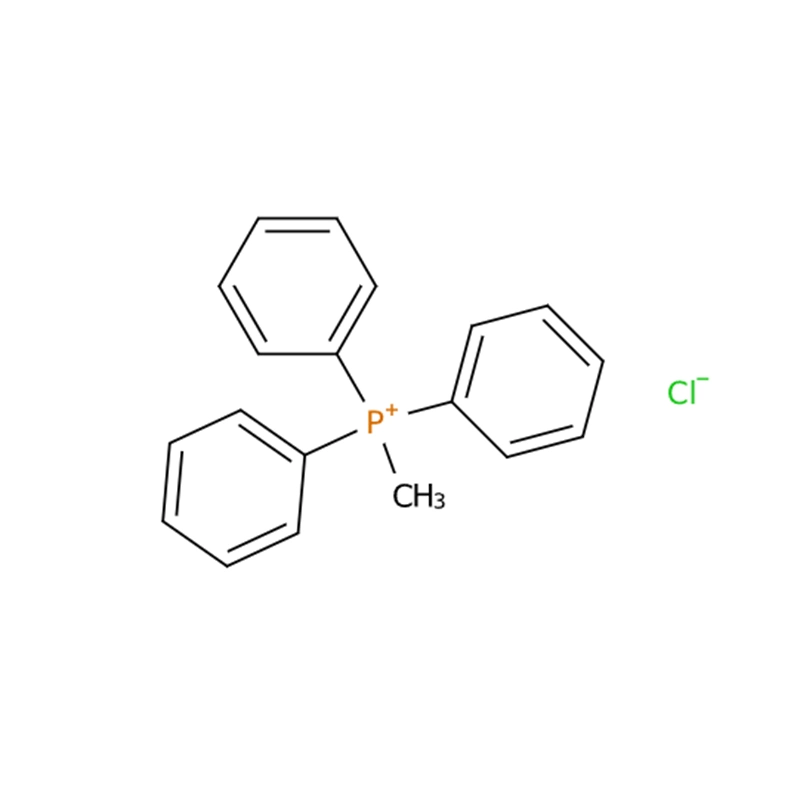
Triphenylmethylphosphonium chloride generally refers to methyltriphenylphosphonium chloride (CAS No. 1031-15-8), a frequently applied organophosphorus salt reagent. Under ambient conditions, it takes the form of white to pale off-white crystalline powder. Its melting point reaches 221°C (with decomposition), and its boiling point is recorded at 332.65°C under 101.3 kPa. The substance shows solubility in methanol.
This phosphonium salt finds broad deployment in the fabrication of pharmaceutical intermediates and various organic synthesis routes.
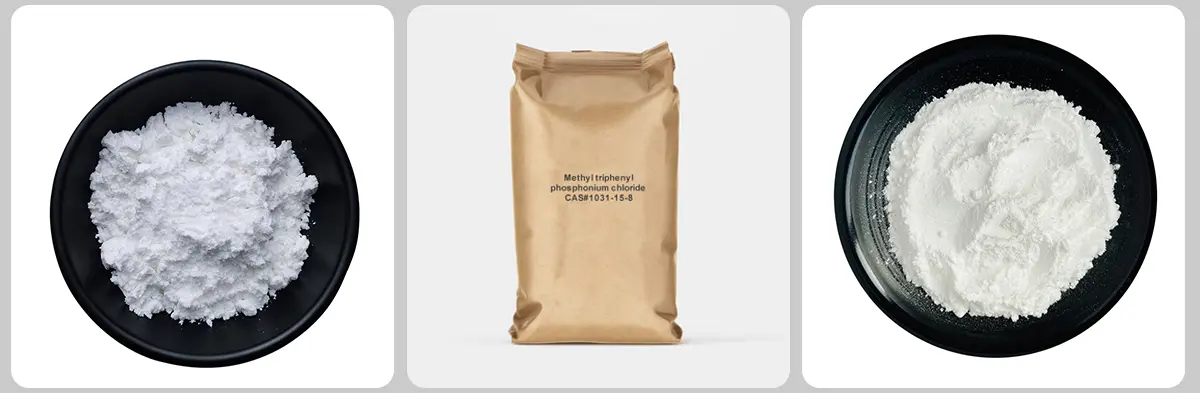 Methyl triphenyl phosphonium chloride Chemical Properties
| Melting point | 221°C (dec.) |
| Boiling point | 332.65℃ at 101.3kPa |
| density | 1.22 at 23℃ |
| vapor pressure | 0.001Pa at 40℃ |
| storage temp. | Inert atmosphere,Room Temperature |
| solubility | Soluble in methanol. |
| form | Solid:crystalline |
| color | White to Almost white |
| Sensitive | Hygroscopic |
| LogP | -1.73 at 20℃ and pH6.3-6.46 |
| Surface tension | 71.4mN/m at 1g/L and 20℃ |
| CAS DataBase Reference | 1031-15-8(CAS DataBase Reference) |
| Hazard Codes | Xn;N,N,Xn |
| Risk Statements | 21/22-38-41-51/53 |
| Safety Statements | 22-26-36/37/39-61 |
| RIDADR | UN 3077 |
| WGK Germany | 2 |
| HazardClass | 9 |
| PackingGroup | III |
| HS Code | 29319090 |
 Primary Uses
Organic Synthesis: Methyltriphenylphosphonium chloride acts as a regular reagent for Wittig reactions to construct carbon-carbon double bonds, and it occupies a vital position in preparing alkene structures.
Pharmaceutical and Chemical Industry: It functions as a key building block for manufacturing multiple pharmaceutical substances, and it also participates in the production of agrochemicals and fine chemical goods.
Laboratory Research: This phosphonium salt is a standard reagent in organic chemistry labs, applied to carry out diverse functional group conversions and assemble sophisticated molecular frameworks.