
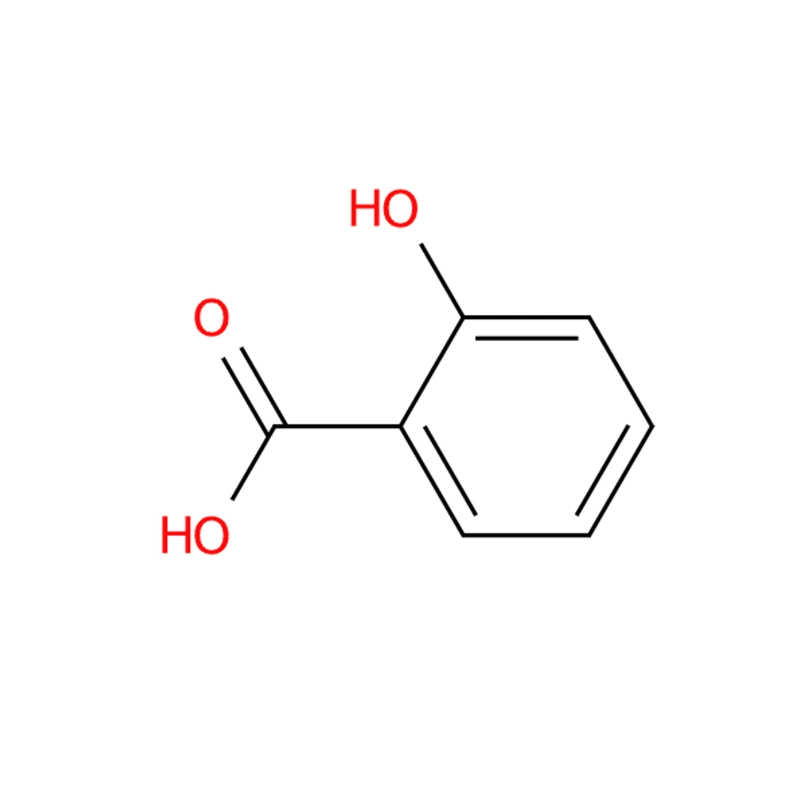
Products Description of Salicylic Acid (CAS# 69‑72‑7)
Salicylic acid represents a crucial intermediate for organic synthesis, finding broad‑ranging deployment across pharmaceutical, agrochemical, dyestuff, rubber, food, as well as flavors‑and‑fragrance sectors.
Within pharmaceutical manufacturing workflows, it serves as feedstock for multiple finished chemical substances: sodium salicylate, methyl salicylate (also known as wintergreen oil), aspirin (acetylsalicylic acid), salicylamide and phenyl salicylate.
For dyestuff production, this compound acts as an essential starting material to yield numerous dye varieties, including mordant pure yellow, Direct Yellow 3GN, Direct Yellow GR, Direct Brown 3GN, Acid Mordant Brown G, Acid Mordant Yellow GG and composite acid‑yellow colorants.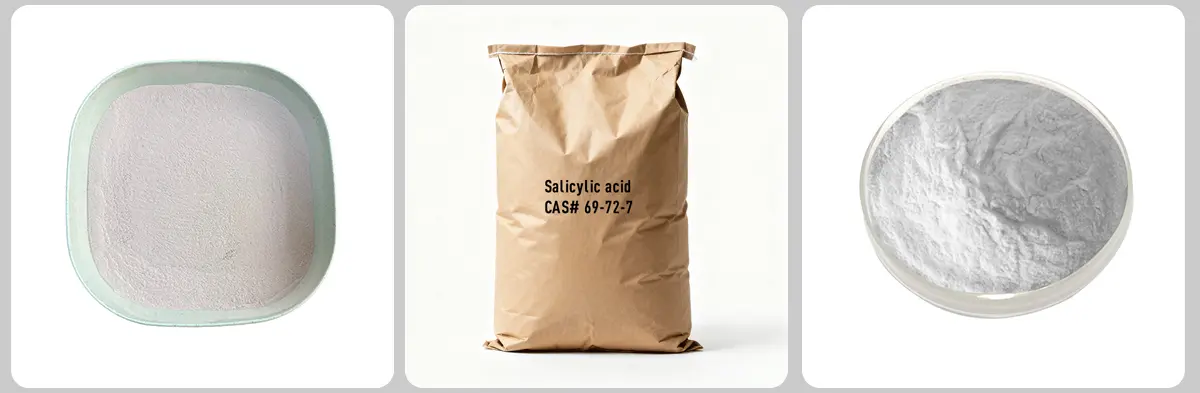
| Product Name: | Salicylic acid |
| Synonyms: | 2-HYDROXYBENZOIC ACID;ACIDUM SALICYLICUM;ACETYLSALISYLIC ACID IMP C;ACETYLSALICYLIC ACID IMPURITY C;FEMA 3985;SALICYCLIC ACID;SALICYLIC ACID;RETARDER TSA |
| CAS: | 69-72-7 |
| MF: | C7H6O3 |
| MW: | 138.12 |
| EINECS: | 200-712-3 |
| Product Categories: | Fluorescent;alcohol| carboxylic acid;Aromatics, Impurities, Pharmaceuticals, Intermediates & Fine Chemicals;Intermediates;Aromatics Compounds;Bioactive Small Molecules;Building Blocks;C7;Carbonyl Compounds;Carboxylic Acids;Cell Biology;Chemical Synthesis;Essential Chemicals;Inorganic Salts;Nutrition Research;Organic Building Blocks;Phytochemicals by Chemical Classification;Research Essentials;S;Solutions and Reagents;Cimicifuga racemosa;Allium cepa (Onion);Allium sativum (Garlic);Aloe Vera;Armoracia rusticana (Horseradish);Cichorium intybus (Chicory);Curcuma longa (Turmeric);Elettaria Cardamomum (Cardamom);Hordeum vulgare (Barley);Panax ginseng;Phytochemicals by Plant (Food/Spice/Herb);Vaccinium myrtillus (Bilberry);Zingiber officinale (Ginger);ACS Grade;Aromatic Compounds;Cosmetics;Organic acids;Medicine of disinfection and antiseptic for dissolving skin cutin hyperplasia and skin mould infection.;Aromatics;Impurities;Intermediates & Fine Chemicals;Pharmaceuticals;69-72-7;bc0001;KT00001 |
| Mol File: | 69-72-7.mol |
Salicylic acid Chemical Properties
| Melting point | 158-161 °C(lit.) |
| Boiling point | 211 °C(lit.) |
| Density | 1.44 |
| Bulk density | 400-500kg/m3 |
| Vapor density | 4.8 (vs air) |
| Vapor pressure | 1 mm Hg ( 114 °C) |
| Refractive index | 1565 |
| FEMA | 3985 | 2-HYDROXYBENZOIC ACID |
| Fp | 157 °C |
| Storage temp | 2-8°C |
| Solubility | ethanol: 1 M at 20 °C, clear, colorless |
| Pka | 2.98(at 25℃) |
| Form | Solid |
| Color | White to off-white |
| PH Range | Non0 uorescence (2.5) to dark blue 0 uorescence (4.0) |
| Odor | at 100.00 %. faint phenolic nutty |
| PH | 3.21(1 mM solution);2.57(10 mM solution);2.02(100 mM solution); |
| Odor Type | nutty |
| biological source | synthetic |
| Water Solubility | 1.8 g/L (20 ºC) |
| Sensitive | Light Sensitive |
| λmax | 210nm, 234nm, 303nm |
| Merck | 148332 |
| JECFA Number | 958 |
| Sublimation | 70 ºC |
| BRN | 774890 |
| Stability | Stable. Substances to be avoided include oxidizing agents, strong bases, iodine, fluorine. Combustible. Sensitive to light. |
| Major Application | Semiconductors, nanoparticles, photoresists, lubricating oils, UV absorbers, adhesive, leather, cleaner, hair dye, soaps, cosmetics, pain medication, analgesics, antibacterial agent, treatment of dandruff, hyperpigmented skin, tinea pedis, onychomycosis, osteoporosis, beriberi, fungicidal skin disease, autoimmune disease |
| InChIKey | YGSDEFSMJLZEOE-UHFFFAOYSA-N |
| LogP | 2.01 |
| CAS DataBase Reference | 69-72-7(CAS DataBase Reference) |
| NIST Chemistry Reference | Benzoic acid, 2-hydroxy-(69-72-7) |
| EPA Substance Registry System | Salicylic acid (69-72-7) |
Salicylic acid is a skincare component approved by the FDA and frequently incorporated into topical preparations designed for acne management. As the most widely adopted beta hydroxy acid (BHA) in cosmetic formulas, it matches oily skin types exceptionally well. It is renowned for penetrating pores to strip away surplus sebum and curb subsequent oil accumulation.
Maintaining open, unblocked pores allows this ingredient to inhibit the development of both whiteheads and blackheads. It also delivers exfoliating effects by sloughing off dead epidermal cells. Its inherent anti‑inflammatory characteristics bring relief for skin disorders including psoriasis.
While this compound can be extracted naturally from willow bark, sweet birch bark and wintergreen foliage, synthetic salicylic acid remains the dominant choice for contemporary skincare manufacturing.