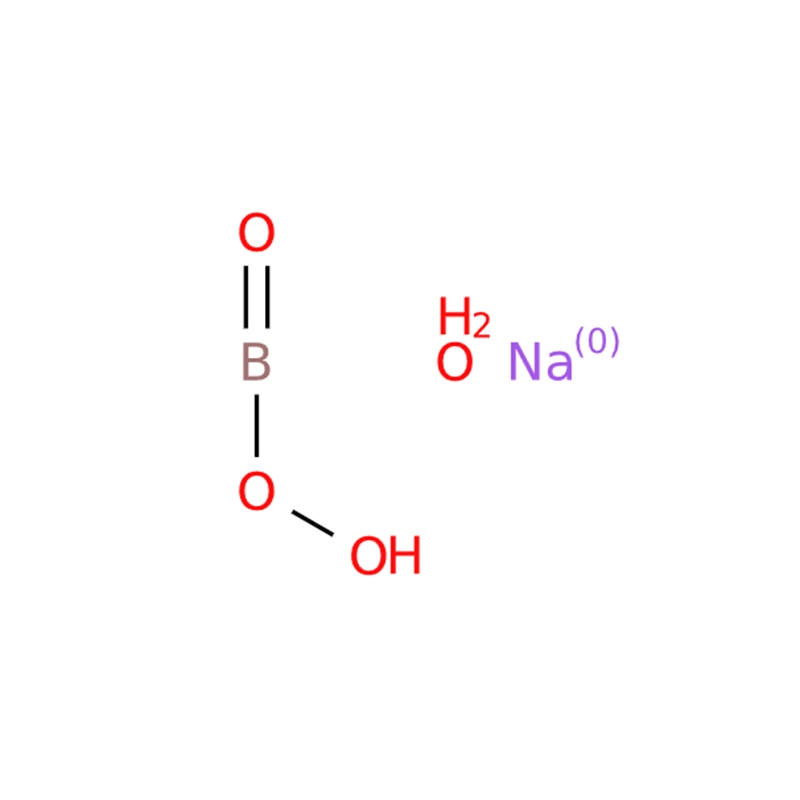
Products Description of Sodium Perborate Tetrahydrate CAS#10486-00-7
Sodium perborate tetrahydrate is a white monoclinic crystalline substance supplied as granules or fine powder. Its melting point is around 63 °C. It dissolves in acids, alkaline fluids and glycerol, yet it only dissolves marginally in water. Its aqueous medium registers an alkaline pH value of roughly 10–11; this solution lacks stability and tends to liberate active oxygen spontaneously.
High-grade sodium perborate maintains comparatively good stability within cool and dry atmospheric conditions. It breaks down at about 40 °C or under humid surroundings and discharges oxygen gas. At 63 °C, it dissolves in its inherent water of crystallization and decomposes into a viscous solid agglomerate. Once the temperature climbs beyond 70 °C, three moles of crystal water are lost, yielding sodium perborate monohydrate.
This perborate salt is prone to thermal breakdown and decomposition triggered by free alkalis. It interacts with dilute acids to generate hydrogen peroxide. Treatment with concentrated sulfuric acid leads to the emission of oxygen and ozone. Moreover, materials including lead oxide, manganese dioxide, potassium permanganate, silver nitrate, copper oxide, cobalt oxide and platinum black can accelerate its decomposition.
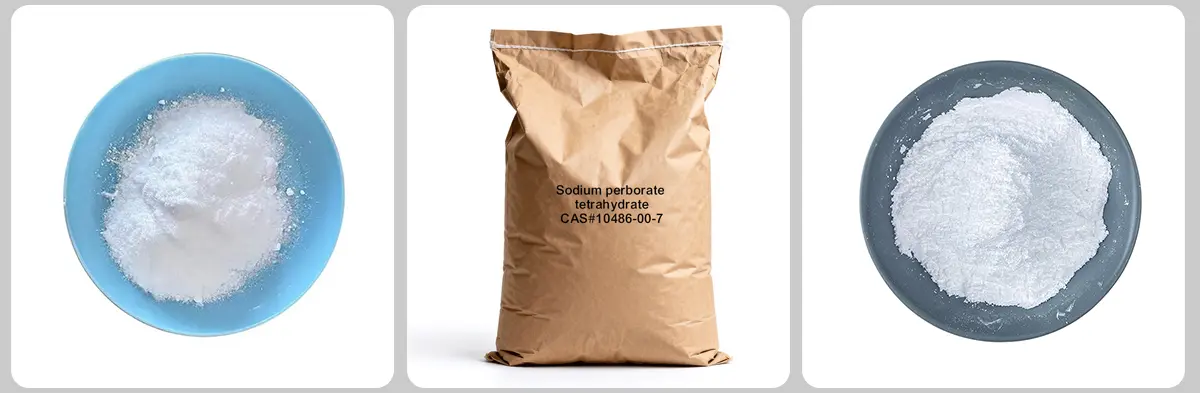
Sodium perborate tetrahydrate Chemical Properties
| Melting point | 60 °C (dec.)(lit.) |
| density | 1.73 |
| storage temp. | Store at +5°C to +30°C. |
| solubility | 23g/l |
| form | Crystalline Powder |
| color | White |
| Odor | Odorless |
| PH Range | 10 - 10.4 |
| PH | 10 (15g/l, H2O, 20℃) |
| Water Solubility | 21.5 g/L (18 ºC) |
| Sensitive | Hygroscopic |
| Merck | 148652 |
| Exposure limits | ACGIH: TWA 2 mg/m3; STEL 6 mg/m3 |
| Stability: | Stable. Incompatible with heavy metal salts, strong reducing agents, strong acids, organic material. May decompose in the presence of air and moisture. |
| CAS DataBase Reference | 10486-00-7(CAS DataBase Reference) |
| EPA Substance Registry System | Sodium perborate tetrahydrate (10486-00-7) |
| Hazard Codes | O,Xn,Xi,T |
| Risk Statements | 8-22-36-36/37/38-62-41-37-61 |
| Safety Statements | 17-26-36-37/39-45-53 |
| RIDADR | UN 1479 5.1/PG 2 |
| WGK Germany | 1 |
| RTECS | SC7350000 |
| TSCA | Yes |
| HazardClass | 5.1 |
| PackingGroup | III |
| HS Code | 28403000 |

Products Description of Sodium Perborate Tetrahydrate CAS#10486-00-7
Sodium perborate tetrahydrate presents itself as white monoclinic crystals, offered commercially in granular or powdery forms. The substance melts at roughly 63°C. It demonstrates solubility in acids, alkaline solutions and glycerol, whereas its solubility in water is limited. Its aqueous system shows alkalinity with a pH range of 10–11; nevertheless, the solution is unstable and liberates active oxygen easily.
High-purity grades stay comparatively stable when kept in cool and dry environments. Decomposition commences near 40°C or under moist conditions, accompanied by oxygen release. At 63°C, the compound dissolves in its own water of crystallization and breaks down into a thick, solid clump. When temperatures rise past 70°C, three moles of crystal water are eliminated, converting the material into sodium perborate monohydrate.
This perborate salt is susceptible to decomposition under heating conditions and when exposed to free alkalis. It undergoes reaction with dilute acids to yield hydrogen peroxide. Contact with concentrated sulfuric acid triggers the release of oxygen and ozone. Additionally, a series of reagents including lead oxide, manganese dioxide, potassium permanganate, silver nitrate, copper oxide, cobalt oxide and platinum black are capable of accelerating its decomposition process.