
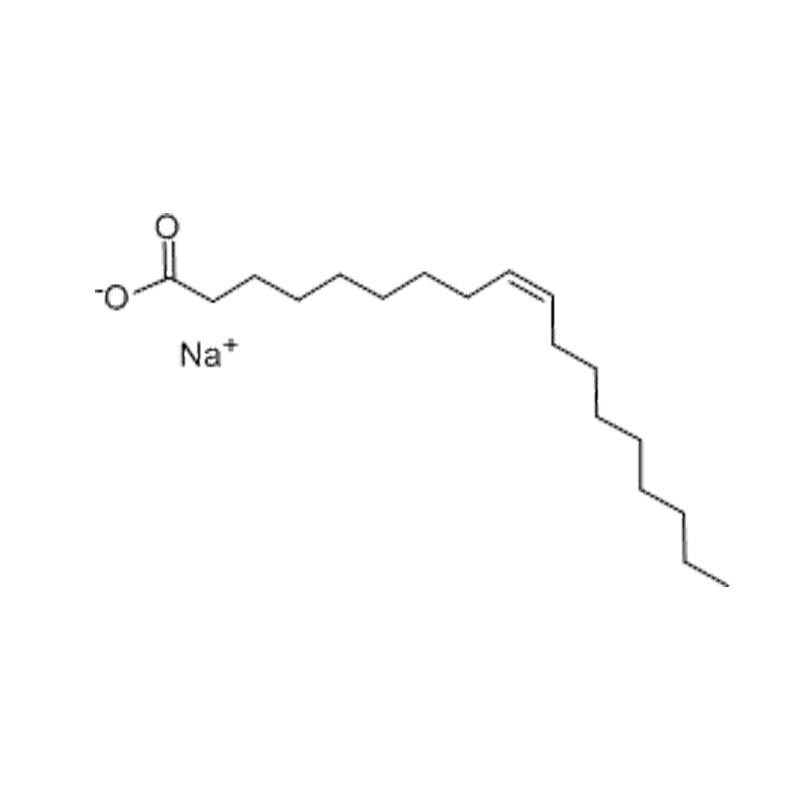
Product Description of Sodium Oleate CAS#143‑19‑1 Sodium octadecenoate, more commonly referred to as sodium oleate, has a molecular formula of C₁₇H₃₃CO₂Na. As an organic substance, it ranks among the major constituents of soap products produced from olive oil and animal tallow.
This chemical can be synthesized when oleic acid undergoes a neutralization reaction with sodium hydroxide. Possessing an amphiphilic molecular framework with both water‑attracting and oil‑attracting segments, sodium oleate delivers outstanding performance in emulsification, penetration and soil removal.
It dissolves efficiently within hot water, which expands its usability across multiple industrial scenarios. It serves as a prevalent anionic‑type surface‑active agent and is frequently deployed as a water‑repellent additive for textile fabrics.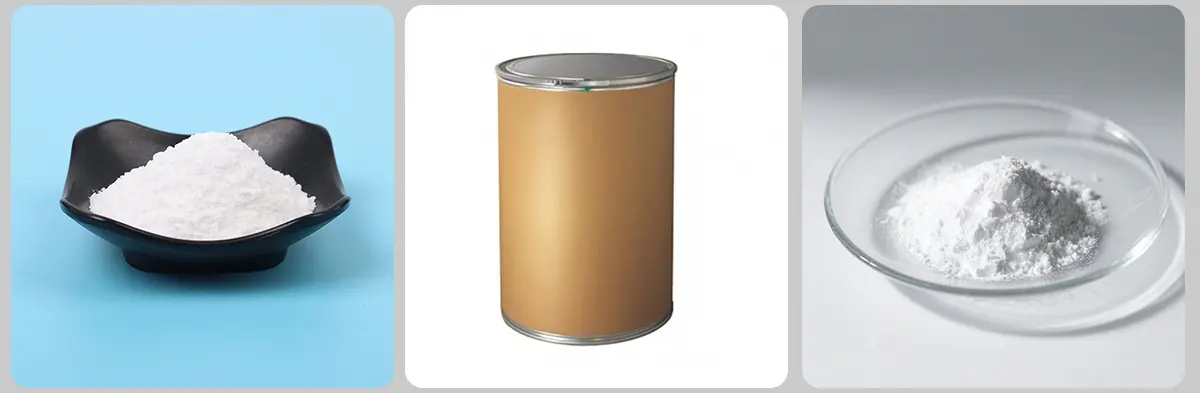
Sodium oleate Chemical Properties
| Melting point | 232-235 °C (lit.) |
| Srage temp | -20°C |
| Solubility | Methanol (Slightly) |
| Form | Powder |
| Color | White to slightly yellow |
| Odor | slt tallow odor |
| Water Solubility | soluble H2O, partially decomposes; soluble alcohol [HAW93] |
| Merck | 146828 |
| BRN | 4046357 |
| Hydrophilic-Lipophilic Balance (HLB) | 18 |
| Dielectric constant | 2.7(20℃) |
| Stability | Stable. Incompatible with strong oxidizing agents. |
| InChI | InChI=1S/C18H34O2.Na/c1-2-3-4-5-6-7-8-9-10-11-12-13-14-15-16-17-18(19)20;/h9-10H,2-8,11-17H2,1H3,(H,19,20);/q;+1/p-1/b10-9-; |
| InChIKey | BCKXLBQYZLBQEK-KVVVOXFISA-M |
| SMILES | C(CCCCCC([O-])=O)C/C=C\CCCCCCCC.[Na+] |
| LogP | 7.698 (est) |
| CAS DataBase Reference | 143-19-1(CAS DataBase Reference) |
| EPA Substance Registry System | Sodium oleate (143-19-1) |
| Safety Statements | 22-24/25-25-24 |
| WGK Germany | 1 |
| RTECS | RK1200000 |
| F | 46318 |
| HS Code | 29161500 |
| Hazardous Substances Data | 143-19-1(Hazardous Substances Data) |
| Toxicity | LD50 ivn-mus: 152 mg/kg RPOBAR 2,327,70 |

Product Application of Sodium Oleate CAS#143‑19‑1 High‑purity sodium oleate finds extensive deployment across mineral separation operations, textile water‑repellent finishing and soap manufacturing workflows. Within multiple industrial scenarios, it functions both as an anionic surface‑active agent and a high‑performance waterproof additive for fabrics.
Apart from industrial usages, analytical‑grade (AR) sodium oleate is adopted for lab‑based biochemical investigations. One typical application involves triggering protein kinase C activation within liver‑derived cells.