
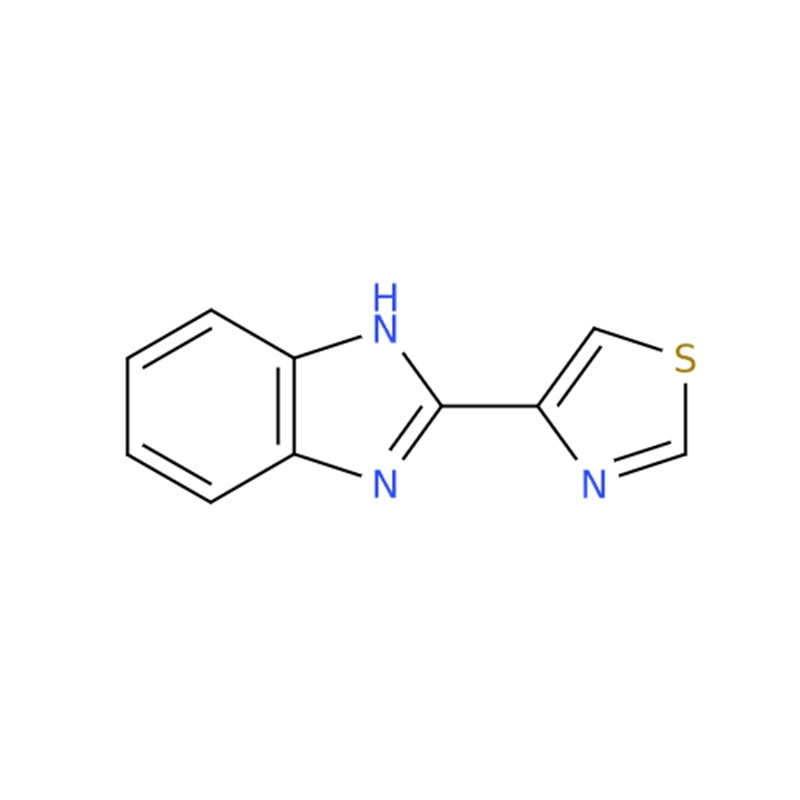
Product Description of Thiabendazole CAS#148‑79‑8
Thiabendazole, which also goes by trade names including Teketol, is a highly potent broad‑spectrum fungicide with global application. It features acropetal systemic movement within plants yet fails to translocate downward to plant basal parts. Boasting persistent protective performance, thiabendazole develops cross‑resistance together with other benzimidazole fungicides.
It displays inhibitory potency toward multiple fungal categories such as Ascomycetes, Basidiomycetes and Deuteromycetes. Thiabendazole is extensively deployed for the prevention and management of fungal crop diseases, as well as the preservation of fruits and vegetables after harvest.
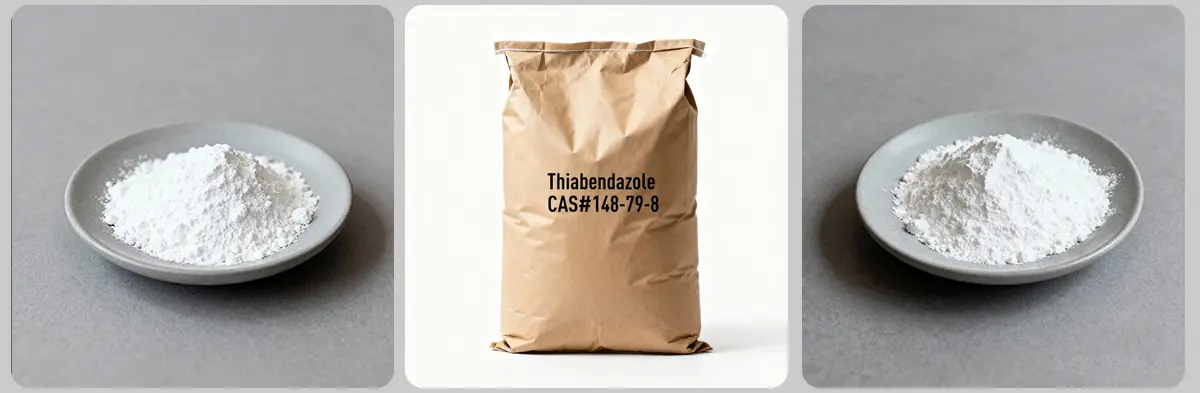
Thiabendazole Chemical Properties
Melting point | 298-301°C |
Boiling point | 446.0±37.0 °C(Predicted) |
density | 1.2271 (rough estimate) |
vapor pressure | Negligible at room temperature |
refractive index | 1.5500 (estimate) |
storage temp. | Sealed in dry,Room Temperature |
solubility | Soluble in methanol and dimethyl sulfoxide. |
form | powder |
pka | pKa 4.7 (Uncertain) |
color | light yellow |
Water Solubility | 0.005 g/100 mL |
Merck | 149289 |
BRN | 611403 |
InChIKey | WJCNZQLZVWNLKY-UHFFFAOYSA-N |
LogP | 2.47 |
CAS DataBase Reference | 148-79-8(CAS DataBase Reference) |
NIST Chemistry Reference | Thiabendazole(148-79-8) |
EPA Substance Registry System | Thiabendazole (148-79-8) |
Hazard Codes | N,Xi |
Risk Statements | 50/53-36/37/38 |
Safety Statements | 60-61-36-26 |
RIDADR | UN 3077 9/PG 3 |
WGK Germany | 2 |
RTECS | DE0700000 |
TSCA | Yes |
HazardClass | 9 |
PackingGroup | III |
HS Code | 29341000 |
Hazardous Substances Data | 148-79-8(Hazardous Substances Data) |
Toxicity | LD50 in mice, rats, rabbits (g/kg): 3.6, 3.1, >3.8 orally (Robinson) |

Product Application of Thiabendazole CAS#148‑79‑8
Thiabendazole is a high‑potency, broad‑spectrum and persistent systemic fungicide. Upon treatment of plant roots, it migrates acropetally toward the plant apex without downward translocation to the basal sections. It can also be administered via foliar spraying, with a suggested dosage ranging from 2.25–3.75 g of active ingredient per hectare.
Thiabendazole delivers satisfactory control against a variety of fungal disorders and root rot of crops, offering both preventive and curative functions. It is also commonly utilized to manage postharvest diseases of citrus, apple, pear, banana and other fruits. For post‑harvest processing, it is generally used in liquid formulation at concentrations of 500–1000 mg/L or 700–1500 mg/L, adjusted according to fruit varieties.
Thiabendazole is acknowledged as a high‑performance broad‑spectrum fungicide and enjoys widespread use across the globe.