

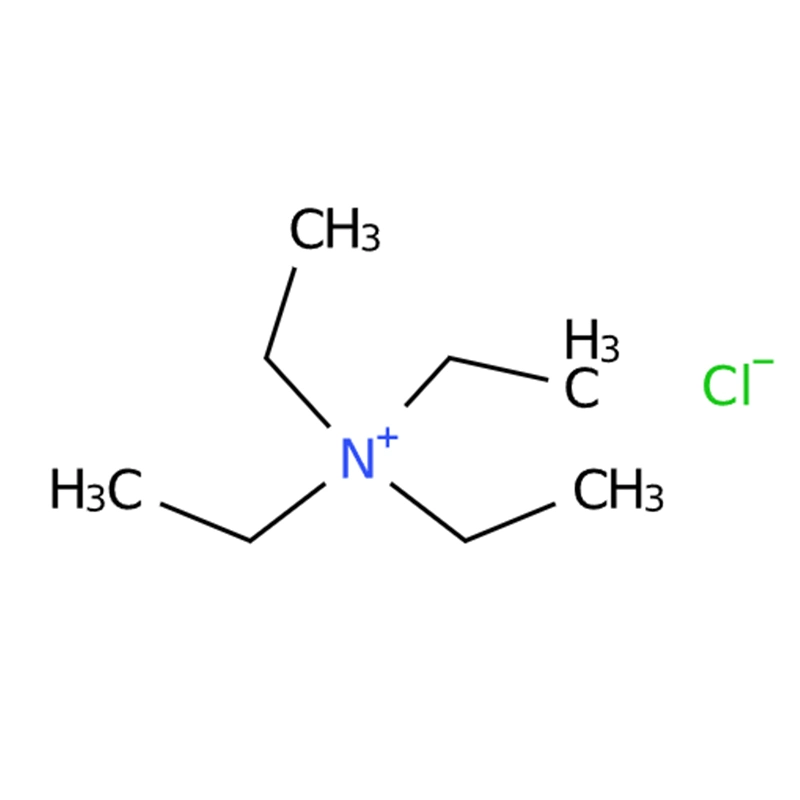
Products Description of Tetraethylammonium Chloride CAS#56-34-8
Tetraethylammonium chloride is an organic entity defined by the molecular formula C₈H₂₀ClN. It can induce non-selective suppression of potassium channels and acts as a qualified substrate for organic cation transporters. Furthermore, this substance shows antitumor bioactivity, which lends it great utility for relevant biological and pharmaceutical exploratory studies.
Tetraethylammonium Chloride Chemical Properties
| Melting point | 39°C |
| Boiling point | 273.32°C (rough estimate) |
| density | 1.08 |
| refractive index | 1.5480 (estimate) |
| storage temp. | Inert atmosphere,Room Temperature |
| solubility | methanol: 0.1 g/mL, clear, colorless |
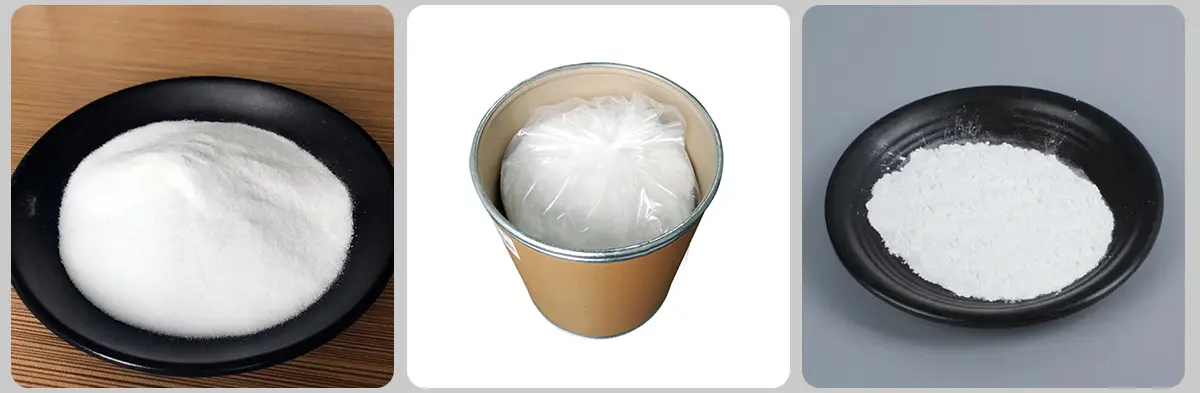
| form | Crystalline Powder |
| color | white to light yellow |
| PH | 4.0 to 7.0(50g/L, 25℃) |
| Water Solubility | Soluble in water, ethanol, chloroform, or acetone |
| λmax | λ: 260 nm Amax: 0.03 |
| λ: 280 nm Amax: 0.03 | |
| Sensitive | Hygroscopic |
| Merck | 149200 |
| BRN | 3563247 |
| Stability: | Stable. Incompatible with strong oxidizing agents. Protect from moisture. |
| InChIKey | YMBCJWGVCUEGHA-UHFFFAOYSA-M |
| CAS DataBase Reference | 56-34-8(CAS DataBase Reference) |
| EPA Substance Registry System | Tetraethylammonium chloride (56-34-8) |
| Hazard Codes | Xn,Xi |
| Risk Statements | 22-36/37/38 |
| Safety Statements | 26-36-37/39 |
| WGK Germany | 3 |
| RTECS | BS6125000 |
| F | 46091 |
| TSCA | Yes |
| HS Code | 29239000 |
| Toxicity | LD50 i.v. in dogs: 55.7-72.4 mg/kg (Keith, Jr.) |

Product Application of Tetraethylammonium Chloride CAS#56-34-8
Tetraethylammonium chloride functions as a phase-transfer catalyst for polymerization reactions and works as an electrolyte in membrane transport research. It is also applied in the qualitative identification of antimony and bismuth, the quantitative assay of gold, as well as polarographic analytical procedures.
Within biological and electrophysiological experiments, tetraethylammonium chloride serves as a potassium (K⁺) channel inhibitor. It is capable of obstructing acetylcholine neurotransmission through the suppression of receptor-triggered potassium ion flux.