


1. Why does the lead brick shielding wall fail to protect?
Most of the lead brick protection standards are not up to standard, not because the lead equivalent of the lead brick itself is insufficient, but because the assembly and supporting details are not handled properly. Understanding the location of failure is the key to doing a good job in shielding construction.
The shielding equivalent does not match. If the protective thickness of the lead bricks is not consistent with the lead equivalent of the surrounding lead doors, lead glass, and original walls, the splicing position will form a weak point in the protection. Even if there is only a small difference in the equivalent, it will cause detectable scattered radiation leakage, and the third-party physicist will not be able to pass the inspection.
Interlocking Structure Not Used Properly Interlocking lead bricks rely on concave and convex bite to eliminate gaps. In many sites, the interlocking bricks are directly laid out as ordinary flat bricks without interlocking alignment; or the upper and lower layers are not staggered and overlapped, forming a straight gap that runs from top to bottom, and the rays will penetrate the shielding wall along the gap. Ordinary rectangular lead bricks are strictly prohibited from being stacked vertically through the seams.
The interface joints are not properly handled. The intersection between the lead brick wall and the original wall, door frame, and observation window frame is the highest risk point. Even if the performance of a single lead brick is qualified, insufficient joint overlap, excessive gaps, and misaligned corner splicing will destroy the overall shielding continuity.
There is no reserve for pipelines to pass through the wall. Cables and pipelines often pass through the wall in the protective area. The pipeline directly passes through the lead brick wall without lead-lined casing shielding, which will leave point leakage holes in the wall and destroy the entire shielding effect.
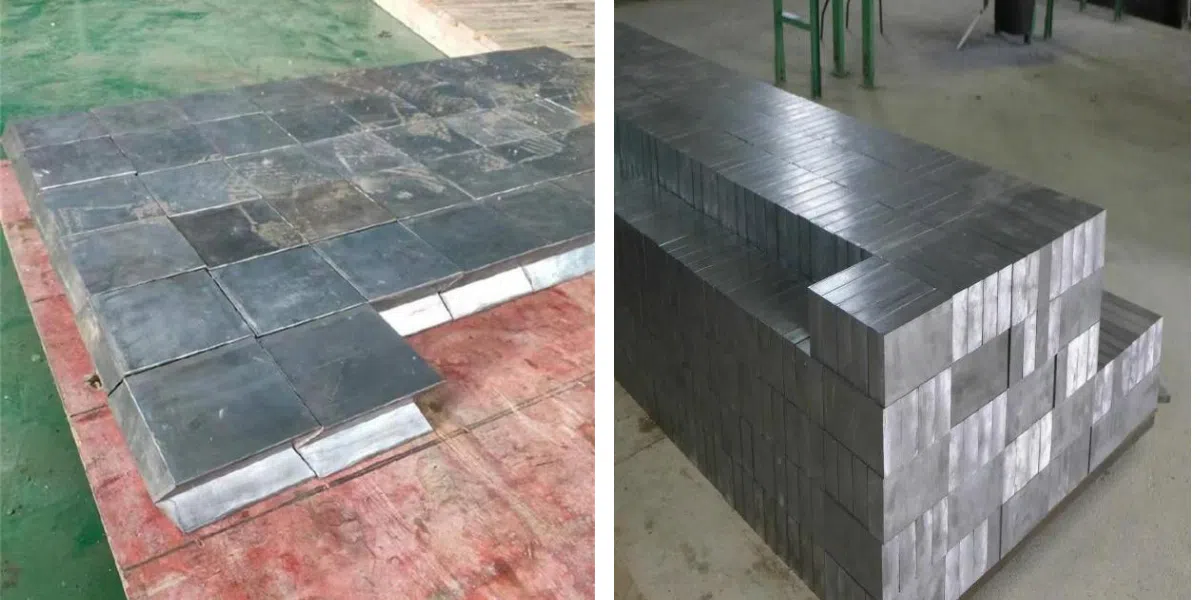
Project background: DR computer room renovation project of a tertiary hospital. The original civil protective walls were partially demolished, and no long-term shutdown was allowed. The construction period of traditional concrete protection is long and cannot meet the hospital's needs for rapid resumption of work. V-shaped interlocking lead bricks are used to build partially reinforced protective walls, which are stacked at staggered seams and overlapped with the original walls, lead doors, and lead glass. All pipeline openings are equipped with lead casings. After completion, a third-party inspection showed that the surrounding dose rates all met the standard. The entire renovation construction only took 2 days, and the computer room quickly resumed receiving medical treatment.
Industrial non-destructive testing workshops often need to adjust equipment stations, and protective walls need to be repeatedly disassembled, assembled and moved. Interlocking lead bricks are a central component of the removable shielding scheme. Many projects only focus on the thickness of the lead bricks and ignore the overall structural stability and anti-scatter design. During the later use, protection frequently exceeds the standard and hidden dangers of wall toppling occur.
2. Common failure points of flaw detection lead brick shielding system
n Insufficient selection of protective thickness: According to the maximum tube voltage of the flaw detector, if the thickness of the lead brick is selected based only on the average working parameters, when the equipment is working at full load, radiation will penetrate the wall, causing the dose around the workshop to exceed the standard.
The stacked structure lacks limit reinforcement. The lead bricks have a heavy weight, but they are only stacked without lateral limit brackets. Frequent movement of people and vibration of equipment will cause the bricks to slip and dislocate, and the bite gaps will open, resulting in radiation leakage and a serious risk of wall collapse.
Lack of ground and bottom treatment. If you directly place lead bricks on an ordinary smooth floor, gaps will appear at the bottom. If the ground is uneven, the lead brick layer will be unevenly stressed, the wall will easily tilt, and the gaps at the bottom will become radiation leakage channels.
Ignore scattered radiation protection. Only focus on main ray direction shielding and ignore side and top scattered rays. Even if the main ray wall meets the standard, scattered radiation will still spread outward from the side gaps.
Lead bricks are widely used in scenarios such as hospital computer room renovation, industrial flaw detection, and temporary shielding of scientific research laboratories due to their advantages of flexible disassembly and assembly and no need for civil construction. However, whether the shielding project is qualified does not only depend on the lead equivalent of the lead brick itself. The wall splicing process, component matching, joint transition, pipeline openings, corners and top surface details are the key to determining the overall shielding effect.A large number of project acceptance failures are not due to quality defects in the raw materials themselves, but to the neglect of system collaboration during the scheme design and on-site assembly stages. Only by coordinating the design of the lead bricks, matching frames, and peripheral protective components as a complete shielding system, and doing a good job of staggered joints, gap overlaps, and special location reinforcements can we completely avoid the risk of radiation leakage and successfully pass the inspection and acceptance by a third-party physicist.