
Which Radiation-Shielding Solution Suits Your Application?
When selecting mobile lead radiation barriers, lead-lined doors and lead curtains, shielding performance is seldom the only factor to consider. Projects often go over budget or fail if teams treat these options as interchangeable, ignoring real world operation, future modifications and inspection requirements during selection.
For facilities balancing practical needs and challenges, the core decision is integrating shielding into daily operations, construction constraints and long-term planning. The final choice depends on budget, facility type, customization needs, installation limits, temporary or permanent deployment requirements, and possible future component relocation.
1.When Are Lead-Lined Doors the Best Choice?
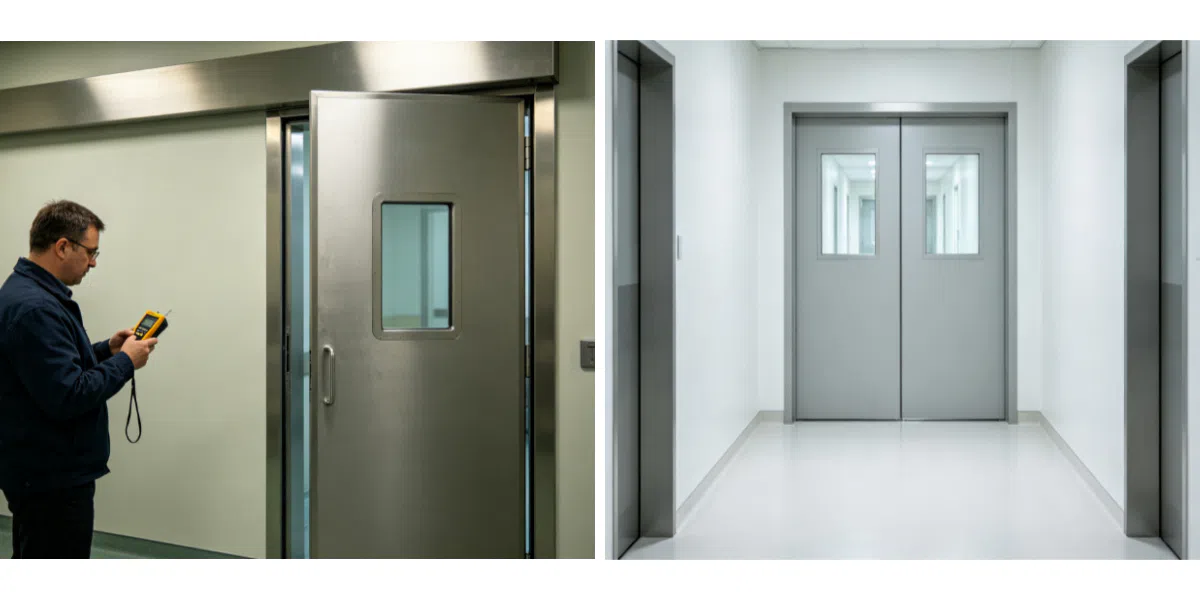
Lead lined doors are optimal when long term shielding reliability, inspection compliance and appearance are top priorities. They fit permanent X ray rooms, CT suites or fluoroscopy rooms with fixed boundaries.
Properly aligned with adjacent walls and frames, they deliver continuous, stable shielding. Unlike mobile options, their performance does not depend on staff positioning or operating procedures.
Key Characteristics and Considerations for Lead-Lined Doors:
Repaintable to match building finishes;
Seamless permanent-style room appearance;
Lead thickness: 1/32-1/8 inch; exact dimensions require review by a qualified medical physicist;
Lead-lined frames reduce transition-joint leakage;
Leaded-glass observation windows available for improved visibility;
Higher cost versus mobile or curtain-type solutions;
Non-relocatable post installation.
Common Pitfalls in Lead-Lined Door Projects
Issues stem from underestimated coordination work. Lead lined doors need precise alignment with wall shielding, door swing, leaded glass and hardware cut outs. Late changes to door size or swing create costly to repair gaps. They remain the most robust, inspection friendly solution for facilities with unchanged room layouts over equipment service life.
2.When Does a Mobile Radiation Barrier Make Sense?
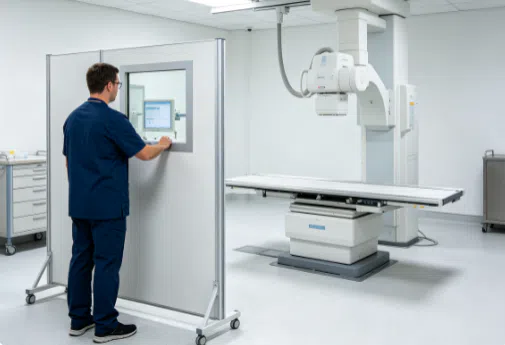
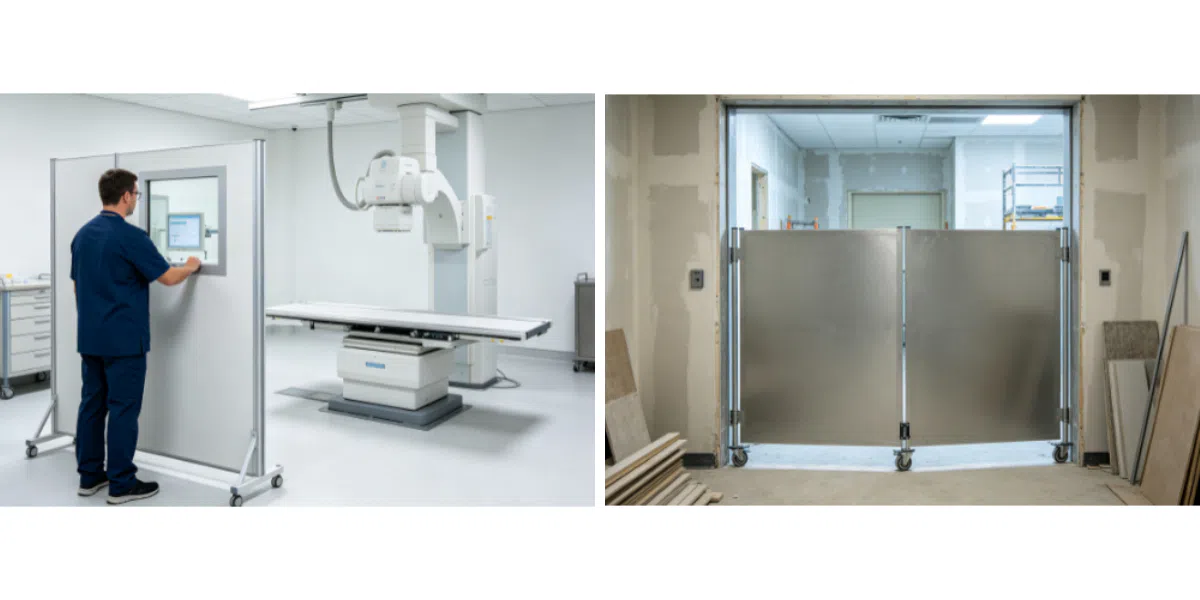
Mobile barriers serve as temporary access-control measures where permanent construction is unfeasible. Adjustable in height and position, they close door openings during renovation, phased construction or door procurement delays and should be treated as interim rather than permanent replacements.
Their greatest value lies in in-room use for technicians and clinicians staying inside during imaging procedures. They lower dependence on building-integrated shielding and move with workflows, instead of forcing workflows to adapt to fixed structures. Only delivering shielding on-demand, they excel in compact rooms, shared or temporary imaging spaces, and facilities with evolving layouts.
Main Features and Advantages of Mobile Radiation Barriers:
Casters support controlled movement for units over 200 pounds;
6-7 foot typical height; protects on site staff and temporarily covers doorways;
Optional leaded-glass windows preserve sightlines and situational awareness;
Suitable where door installation is impractical or unapproved;
Works for compact, irregular-shaped or multi purpose spaces;
Cost-saving substitute for multiple lead lined doors;
Ideal for multi-room X-ray shielding under permanent-construction budget constraints;
Relocatable between rooms or separate facilities;
Effective temporary solution pending permanent door delivery or construction completion;
No on-site building work, framing or inspection coordination;
Re-positionable by one two people based on unit size and lead thickness.
Important Limitations to Note
Correct positioning is required for every deployment. As temporary doorway closures, 6-7 foot height limits mean barriers alone cannot adequately shield taller openings. For higher gaps or overhead leakage with acceptable radiation exposure, lead curtains offer better coverage.
They work best with clear usage purposes, staff training and full understanding of room geometry and exposure conditions. Problems arise if treated as permanent building elements instead of flexible task-oriented tools.
3.When Should You Choose Lead Curtains?
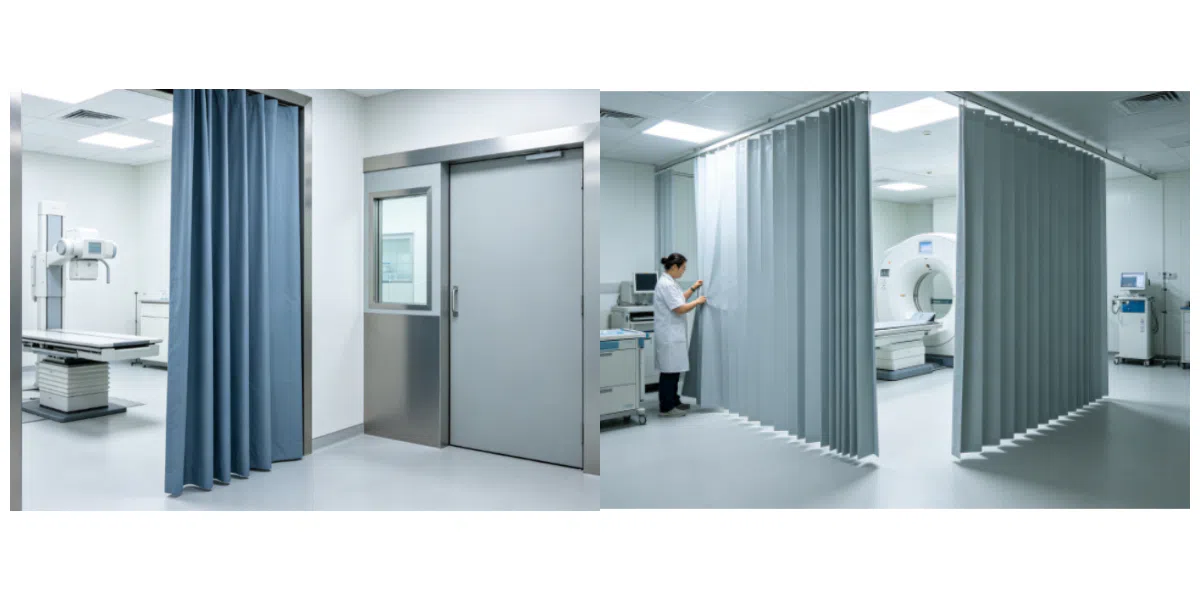
Lead curtains fit low-radiation-exposure applications prioritizing flexibility and fast installation over permanent finishes. They effectively substitute doors for requirements at or below 1/16-inch lead equivalent.
Main Features and Advantages of Lead Curtains:
Designed for low-level shielding applications;
Rated up to 1/16-inch (1.5 mm) lead equivalent; unsuitable for higher-demand scenarios;
Adjustable shielding strength for modest protection requirements;
Lightweight structure, installable by a single person;
Capable of dividing rooms into independent functional zones;
Fast installation with minimal on-site disruption;
Height can exceed 7 feet, covering blind spots where mobile barriers fall short.
4.Why Customization and Installation Constraints Matter
Customization covers more than aesthetics, including shielding-wall-ceiling interfaces, overlap at doors/frames/curtains, plus workflow visibility and personnel circulation. Installation complexity varies greatly: doors require structural support, precise alignment and inspection coordination; mobile barriers need no construction but size governs doorway passage and blocking capability; curtains install quickly yet demand accurate mounting and overlap planning. Neglecting these points early triggers late-stage modifications, higher costs and greater inspection risks. There is no universal solution. The best option is determined by real-world usage rather than purely theoretical paper-based performance.
As shielding-equipment suppliers, we regularly encounter project difficulties stemming from insufficient consideration of system level interactions in early stage planning. When shielding selections align with a facility’s current workflows and anticipated future changes, projects can avoid unnecessary rework and inspection-related complications. If you have upcoming project plans or would like advice on applying different shielding approaches to your space, we are ready to answer your questions and resolve concerns at an early stage before they turn into costly issues.


