
Core Performance
Radiation Shielding Performance
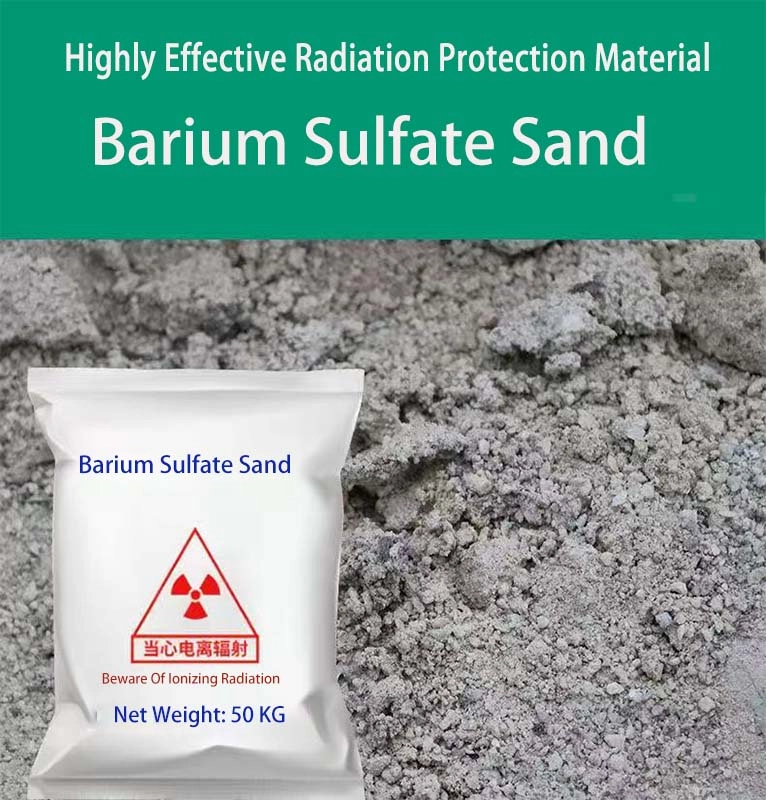
Featuring a high barium element density of 4.5g/cm³, barium sulfate sand absorbs X-rays efficiently via the photoelectric effect. A 250mm-thick barium sand wall achieves over 99% attenuation for 90kV X-rays, reaching a lead equivalent of 1.5mm.
With graded particle sizes ranging from 0.3mm to 3mm, the material delivers void-free integral casting. Its overall shielding uniformity is 40% higher than traditional lead plate shielding structures, ensuring stable and consistent radiation protection across the entire wall surface.
Physical Properties
The finished shielding layer provides a bulk density of 3.0–3.5g/cm³. Adopting pore-free cold-pressed forming characteristics, it achieves a compressive strength of ≥30MPa for solid and durable structural performance. The material maintains a slump value of ≥180mm, enabling excellent self-leveling fluidity to fill irregular and shaped structures thoroughly and eliminate construction blind corners.
Safety & Environmental Protection
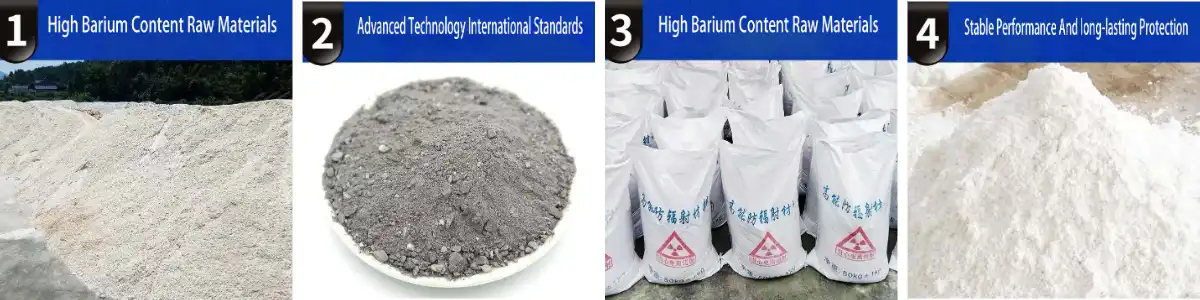
Made from natural high-purity barium sulfate (BaSO₄ ≥96%), the product contains lead content below 0.001% with zero heavy metal pollution risks. It has passed ISO 10993 biocompatibility certification. Meanwhile, it meets Class A radioactive safety standards specified in GB6566, with an internal irradiation index ≤0.3, ensuring safe application in medical enclosed environments.
Five Major Application Advantages
50% Cost Reduction: Replaces traditional lead plate and steel structure solutions, cutting overall project costs by half.
60% Faster Construction: Can be directly mixed with concrete for integral pouring. A standard 200㎡ radiation shielding machine room can be completed within only 3 days.
Excellent Crack Resistance & Long Service Life: The dry shrinkage rate is lower than 0.02%, effectively preventing structural cracks and radiation leakage for up to 30 years of long-term service.
Fire & Moisture Resistance: Boasts a high melting point of 1580℃ and maintains stable shielding and physical performance even in a 95% high-humidity environment.
100% Seamless Shielding: Integral one-piece casting eliminates splicing gaps, completely avoiding the radiation leakage risk existing in segmented lead plate installation.
Key Technical & Construction Parameters
Mixing Ratio
Weight ratio: Barium sand : Cement : Quartz sand = 3.5 : 2 : 4.5; Water-cement ratio: 0.42–0.45
Construction Specifications
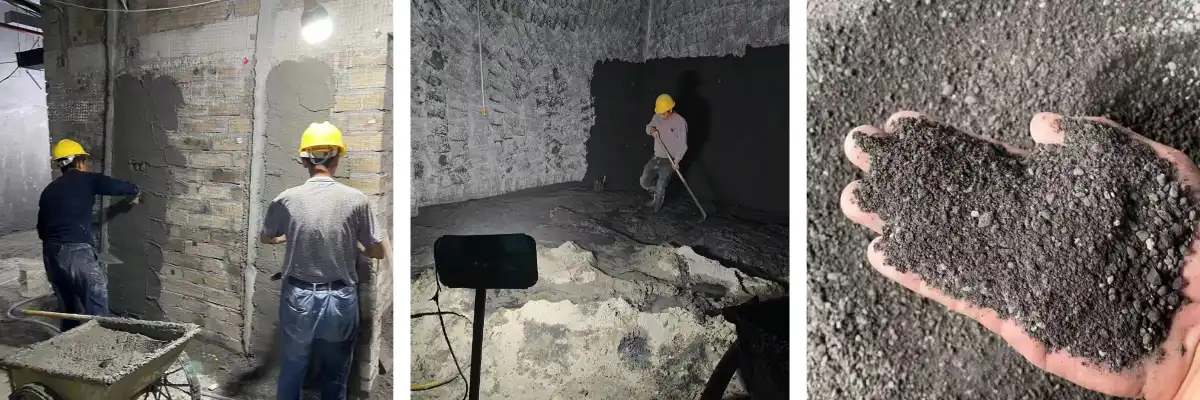
Adopt layered pouring with a single layer thickness ≤40mm, followed by mechanical vibration compaction to ensure compactness. All wall corners and openings are locally thickened by 50% for anti-crack reinforcement. Standard curing process includes 7 days of covered moisture curing plus 21 days of natural air curing.
Acceptance Standard
Under 150kV X-ray detection, the residual radiation leakage dose is controlled below 2.5μSv/h, fully complying with GBZ130-2020 industry specifications.
Typical Application Scenarios
Dental DR Room: A 250mm barium sand shielding wall achieves 1.5mm lead equivalent for 90kV X-rays; embedded barium sand reinforcement is applied at door frames for enhanced sealing protection.
Orthopedic Radiology Room: 350mm-thick floor pouring reaches 2.5mm lead equivalent for 150kV rays, with a floor bearing capacity ≥5kN/m².
CT Equipment Base: Partial barium sand casting replaces conventional lead plates, reducing costs by 40%. A 1mm thin lead sheet is additionally equipped to shield 140kV scattered rays for comprehensive protection.

Application Limitation
This barium sulfate sand material is suitable only for medium and low-energy rays ≤150kV. For high-energy radiation scenarios such as PET-CT rooms, boron-containing shielding concrete or lead plate solutions are recommended.
Economic Benefit Comparison
VS Lead Plate Solution: Cuts overall construction cost by 50% and simplifies the complex steel support structure.
VS Ordinary Concrete: Boosts radiation shielding efficiency by 300% and reduces required wall thickness by 40%, saving space and materials.
High-Energy Upgrade Solution: For scenarios above 150kV, the composite structure of barium sulfate sand + 0.5mm lead sheet delivers qualified protection while still lowering costs by 35% compared with full lead plate schemes.


