
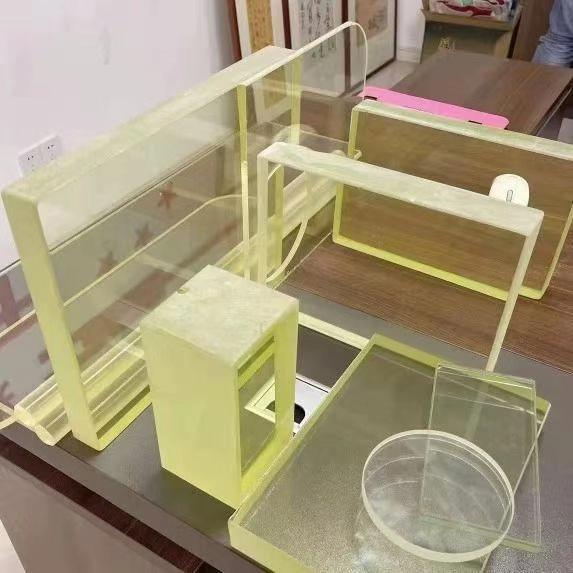
This specialized optical shielding glass is manufactured by fusing high-proportion lead oxide into silicate raw materials under vacuum high-temperature casting, gaining double the density of standard float glass. Internal lead atoms absorb low-energy X/γ-rays (≤100kV) through photoelectric effect and Compton scattering, achieving over 90% radiation blockage with only 5mm thickness. Unlike opaque lead plates or concrete barriers, it retains premium optical performance: consistent high transmittance, negligible image distortion, and optional anti-glare coating to support uninterrupted procedural monitoring in high-radiation zones.
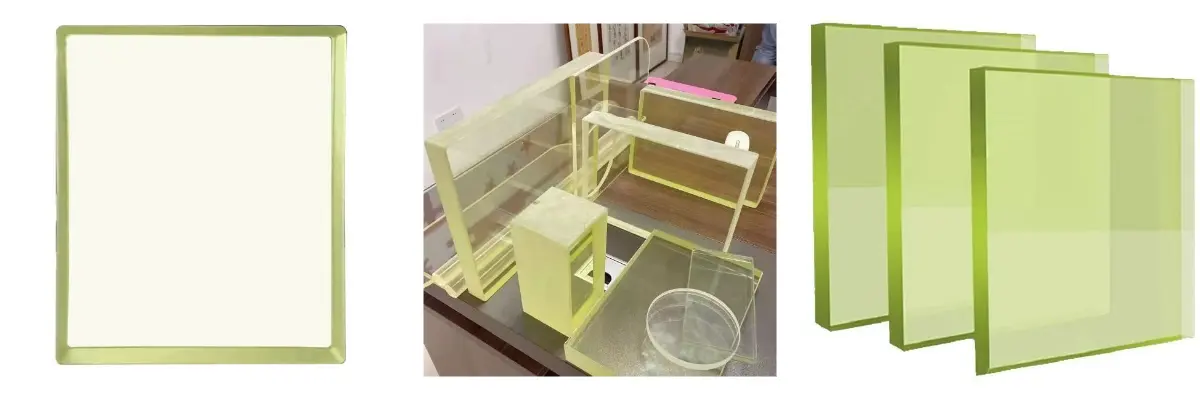
Interventional operating room built-in viewing wall: 15–20mm thick monolithic lead glass embedded into partition walls, delivering ≥99% shielding efficiency against 120kV scattered fluoroscopy radiation.
CT/MRI control room curved observation panel: Custom bent lead glass with 0.5–1.0mmPb lead equivalent fully complies with GBZ 130-2020 radiology control room construction standards.
Nuclear medicine hot cell dispensing hood: Integrates reserved manipulator operation cutouts, limiting surface residual dose rate below 2μSv/h to block mixed β/γ isotope radiation.
DR suite permanent viewing insert: Standard 60×120mm sized glass panels pre-installed inside liftable fixed shielding frames, cutting operator radiation exposure by 90%.
Veterinary PET radiotherapy cabin: Multi-layer explosion-proof laminated lead glass door panels, balancing animal behavioral observation and high-level gamma shielding.

Vacuum melting & casting: Lead oxide and silicate substrates are melted at constant 1200℃ vacuum environment to eliminate internal air bubbles and guarantee uniform lead distribution across the whole pane.
Surface chemical tempering: Post-fusion hardening treatment raises surface scratch resistance to Mohs 4.5; an additional polyurethane anti-abrasion coating further prevents daily surface scratches.
Composite lamination & hot bending:
Sandwich explosion-proof structure: Lead glass core bonded with polyethylene shock-absorbing interlayer, with total impact resistance exceeding 50J for collision-prone medical areas.
Arc hot forming: One-piece thermal bending creates smooth curved panels up to 150°, matching the curved wall observation demands of DSA interventional cath labs.
Exclusive transparent shielding solution: Breaks the vision-blocking limitation of solid lead plate and concrete walls, allowing direct real-time oversight of all radiation operation areas without dismantling protective barriers.
Space-saving thin-wall design: Under identical lead equivalent rating, glass panel thickness is reduced by 60% versus solid concrete shielding walls, maximizing usable clinical floor space.
Diversified fixed installation modes: Supports wall embedding, ceiling hanging and cabinet mounting, far easier for permanent radiology suite renovation than welded fixed lead sheet walls.
Ultra-low lifecycle maintenance: Stable glass composition requires zero regular maintenance over 20-year service life, unlike lead plates that demand periodic anti-oxidation coating and rust inspection.
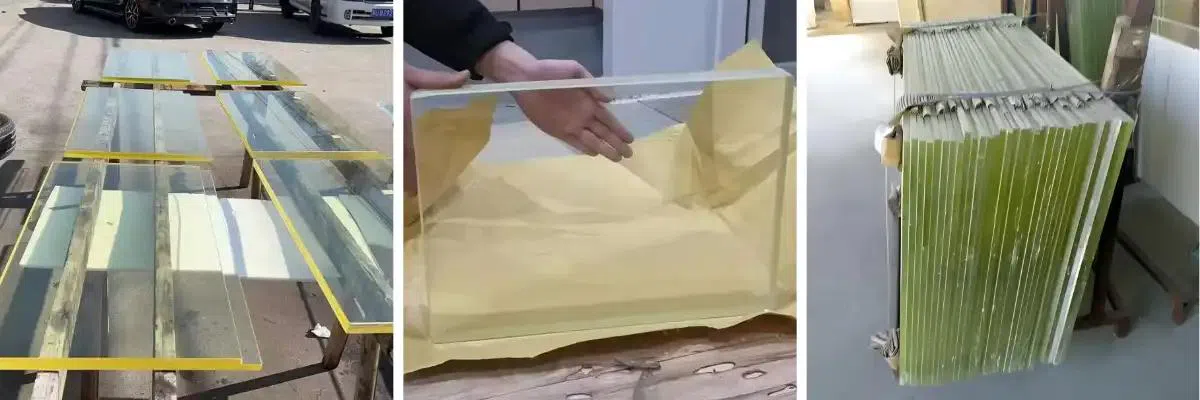
Cleaning restrictions: Hydrofluoric acid and high-concentration alkaline disinfectants are forbidden, as they will erode the glass internal network structure; only neutral medical detergent and soft microfiber cloths are allowed for wiping.
Anti-breakage transport rules: All four glass edges must be protected with solid wooden corner brackets during delivery and installation to avoid micro-cracks from impact.
Periodic performance inspection: Conduct full shielding attenuation and light transmittance testing every 2 years. Replace panels immediately if visible light transmittance drops by over 10%.
Radiation shielding lead glass takes integrated transparent permanent shielding as its core differentiation, combining uniform ionizing radiation absorption and distortion-free optical monitoring functions. Customizable thickness, curved arc shape and explosion-proof laminated structures, paired with long-term chemical and mechanical stability, make it an irreplaceable monolithic transparent shielding component for fixed high-risk radiation sites including diagnostic radiology suites and nuclear research labs, greatly lifting clinical operation safety and workflow efficiency.


